Showing posts sorted by relevance for query Short Beach. Sort by date Show all posts

Friday, January 25, 2013

From the Octopus Tree to Short Beach


 A tenth of a mile from the parking lot at Cape Meares stands this amazing Sitka Spruce. It is not possible to photograph the entire 105 foot height. The Octopus Tree is, according to the sign, "more than 46 feet in circumference".


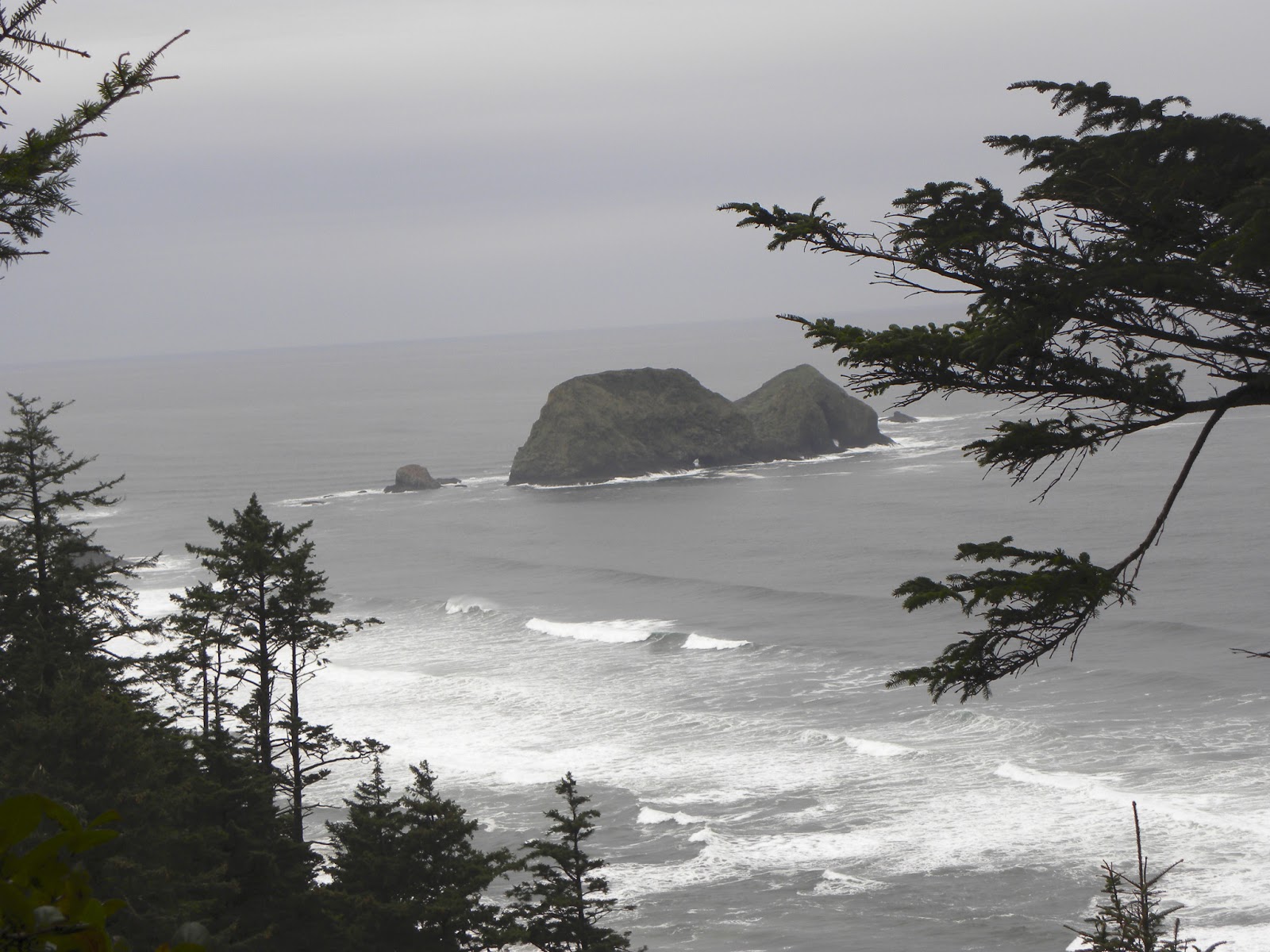
We followed a path south leading from the Octopus Tree through the temperate rainforest filled with ferns and Sitka Spruce.  From every break in the trees was a lovely view toward Short Beach and Three Arch Rocks at Oceanside.


A soft mist fell as we strolled through tall ferns and taller, much taller, trees. Mist is usual in a rainforest that averages over 100 inches of rain a year.


Some of these Sitkas were huge. Johnny measured his spread against this one.


Fallen giants had giant root wads.


This one lying for many feet along the path had almost returned to the soil.


And always the view of Three Arch Rocks... here with two arches showing.


 Where the canopy opened and sunlight reached the ground, salal grew thick.


From this angle, zoomed up, we could see the arch well in one of the Three Arch Rocks, "Finley".


Eventually we came to the road and hiked back to our car, then drove south to Short Beach, one of my favorite spots for finding Black Oystercatchers. Although we had passed Short Beach on our way to Cape Meares, I wanted to save this spot for last so I could dawdle as long as I wanted.

The Staircase of 1,000 Steps, as it is known, is a rustic and steep stairway with many benches for resting along the way. The staircase was created by locals to reach the beach, formerly accessible only by a slippery trail that had been the ruin of many hikers. Some of the locals may regret the improved access as this formerly secluded beach has become quite popular, especially with fisher folk.


A waterfall tumbles to the beach.


But it is man made, directing rainwater. Impressive nonetheless.


I don't know what's in that rainwater, but gulls and oystercatchers love to bathe in it just before it reaches the sea. This day it was populated by gulls only.


Elsewhere on Short Beach, we found at least six Black Oystercatchers, pretty distant for photographs.

Most did not pose nicely like the one above. Instead they flew over the surf screaming and chasing one another. But wherever they were, they made my day at the coast complete. I love these noisy, red-billed, flamboyant birds of the Pacific coast.


Sunday, June 22, 2014

Home Alone

Home Alone. That's a joke. I have 3 horses, about 20 goats, 3 turkeys, 18 or so chickens, 2 dogs, 1 sheep, 2 llamas... and 2 pigs. I am *never* alone. While Johnny was gone for a week visiting the California kids http://lindafink.blogspot.com/2014/06/johnnys-trip-to-california-kids.html, I kept busy feeding and cleaning up after animals, weeding, hoeing, mowing, digging tansy, weeding, mowing... you get the picture. But none of that makes good copy. So I'll confess: I also took off a couple days to go to the coast and survey birds. And sea stars.

On Sunday, June 15, friend Nancy and I spent a long day at the coast, surveying Black Oystercatchers at Cape Meares, Short Beach, and Cape Lookout. The only place we found any were at Short Beach, where I was sure a pair was nesting but could not verify it. However our main focus at Short Beach turned out to be a sea star survey.

I had received an email from COASST, the people in charge of the beached bird survey that Johnny and I do, just before the weekend asking their volunteers to monitor sea stars while at the beach during the low tides of the upcoming weekend. Sea Stars (commonly but incorrectly known as starfish) on the west coast have come down with a devastating wasting disease. COASST, based at the Univ. of Wash., in collaboration with Cornell Univ., is conducting surveys of sites on the northwest coast. So Nancy and I ran a transect on Short Beach and counted sick sea stars. There were lots of them.

The disease begins to rot their arms until they sever and sometimes go walking off by themselves (the arm, that is) while the main body withers, rots, and dies. The arm also dies. It is pretty gross. First, though, the signs may be subtle, with just a bit of shriveled or rotten looking part of an arm. Here are some of the stars we found in various stages of illness.


I left Nancy to do most of the sick sea star surveying, while I tried to figure out what was going on with the BLOY (Black Oystercatchers). At low tide, I can get farther out to hopefully see more of the ledge where the Oystercatchers have nested in the past and I was sure were nesting this year. But not far enough as it turned out. In this photo, an Oystercatcher that had been standing on the ledge is taking off, lower left. Although I watched on and off, I could not tell for sure if the BLOY were feeding chicks, incubating eggs, or neither one.


As the tide came in, we left and headed to Cape Meares, where we heard but did not see BLOY. However, the camp hosts there are keeping an eye out for them and will keep notes. Plus friend John Woodhouse checks almost every day and lets me know any BLOY news.

So on we went to Cape Lookout (back to Cape Lookout as we had stopped in the morning but it was raining so useless to look). We found no BLOY on the rocks but we had a consolation prize of a sky full of skydivers, coming off Gammon Point above the park and landing on the park beach.

We went up to the Point and watched this one taking off.


Nancy, a retired marine biologist, thought the day was great fun, especially the sea star survey, but I was not so thrilled. I wanted to figure out what was going on with those Short Beach BLOY.

So... frustrated at my lack of success, I came back at another low tide three days later, when I was able to walk farther out for a slightly better angle. An Oystercatcher was on the ledge. I could see it apparently sometimes going for food but never could tell for sure if it brought food back for chicks. I definitely could not see chicks!

Note the two little rock bulges in front of the BLOY. Those are what I used to judge what angle I was looking at.


I backed away to where I was farther from the ledge but at a better angle. Note those two rock bulges. I can now see a bit farther left, but not into where the chicks, if there were any, must have been.

 
After two hours, the tide was coming in and I gave up. On the way back up the mile long beach, three sub-adult Bald Eagles were attacking a gull (or something) that would try to lift off the ocean only to be hit by an eagle and go down again. I watched until the eagles gave up.


As I climbed the long, rustic staircase back up to the road, I remembered that last year I had found a spot on the road where there is a break in the shrubbery allowing a view (distant) of the nest ledge. I set my scope up in that gap. It was over a mile from my scope to the nest ledge. I did not hold out much hope of seeing anything at that distance. But I did.

The angle was better and I could see farther to the left and behind those two rock bulges. An adult BLOY landed as I watched and put something down on the rock, pecking at it as they do when they're breaking up mussel pieces to make them bite-sized for chicks. But I could see no chicks. It was a "long" way away. After the adult flew off, I kept watching. And lo and behold two gray blobs moved! They were chicks! There was a third gray blob that did not move so I don't know if that was another chick or a gray rock. The adult soon returned and again put something down on the rocks for the gray blobs.

I took photos, but the only reason I can see chicks in these photos is because I knew where they were. However, if you have a good eye (and imagination) you might be able to see the one on the left inside the red circle (which friend Dawn kindly put on my photo to corral the chicks). The left one is standing and you can see its shadow. Okay, I can see it's shadow. The second photo is cropped to make the chicks bigger but also blurrier. You'll have to take my word for it. There are chicks at Short Beach!


The next day, Thursday, I mowed around the perimeter of a field in the morning, then showered, drove to the feed store in Dallas for feed and then to Salem to pick up Johnny at the Amtrak station.

It was great to have him home, especially since the next day, Friday, was the best tides of the month for doing our beached bird survey at Salmon River. After our canoe trip to and from the survey beach, we hike the cliffs at Road's End to check on the three BLOY nests at that site. So many surveys; so little time...


Saturday, February 6, 2010

Short Beach

My mission to photograph juvenile Black Oystercatchers (BLOY) began yesterday at Short Beach. Short Beach is actually not very short. But a little stream called Short Creek runs into it, hence the name. Short Beach deserves a prettier name because it is a very pretty spot. The Oystercatchers like it a lot. They, along with lots of gulls, bathe and drink in the freshwater flowing out of a culvert and across the beach to the ocean. Or they do when the beach isn't full of people and dogs.


Yesterday, it was full of people and dogs. So the birds were on offshore rocks and rocky headlands. Determined to find a juvenile BLOY to photograph, I climbed down the makeshift stairs to the beach and clambered over slippery boulders to where I could see north (photo left) toward Cape Meares and south (photo right) past Lost Boy Cave to the rocks off Oceanside. From that vantage point, I could see BLOY in both directions, plus one juvenile on the same rocky outcropping I was on.

Eventually, I got an okay photo, although mostly the blessed bird kept the back of its head toward me so I couldn't see the bill, which is the defining difference between adults and juveniles. Juveniles take months (how many months I'm trying to find out by photographing them at various times) to go from a dark bill to an all orange bill. Their eyes start out dark, I'm told, and become adult yellow. Both adults and juveniles have red eye rings but the adults' are more obvious. Or something. You couldn't prove it by me or my photographs. At least, not yet. Pictured are the juvenile (left) and an adult (right) I photographed yesterday.

Naturally, I need many more trips to the beach to figure this out.

Tuesday, May 21, 2013

From Oceanside to Cape Meares

On Wednesday, May 15, we finished our Black Oystercatcher site surveys. First thing in the morning (after chores), we returned to our viewpoint on the north side of Cape Lookout to check the offshore rocks when the sun was behind us instead of shining in our eyes. Still no BLOY.

Then it was up the coast past Netarts Bay to Oceanside, which we hit just at low tide. We hiked through the tunnel and found a pair of BLOY feeding on an exposed tidal rock. At the same time we were looking at them, friends John and Barbara were just north at Short Beach looking at five more. It was nice to have someone glassing Short Beach at the same time we were at Oceanside so we would be sure that there were, indeed, seven BLOY in the area and not two that flew from one area to the next to be counted again.

After lunch at Brewin' in the Wind at Oceanside, a favorite rendezvous spot with Tillamook friends John and Barbara, we all drove north to Short Beach, where we found five BLOY still hanging out. For some reason, gulls and BLOY love the fresh water that flows into the ocean from a reservoir up in the hills. They drink and bathe and splash. Here are two BLOY enjoying a dip along with many gulls.


 Farther north on the beach, another pair were foraging on an exposed rock. They had just flown from the north end of the rocky beach, where another BLOY was still poking around.


Then we were off to Cape Meares, where John and Barbara have been keeping watch on the nesting peregrines and nesting Black Oystercatchers... for many years. The peregrines were out of sight this day but two pair of BLOY were each hanging out in their usual nesting areas, one on the north toe of the cove and one on the south toe. Neither pair are nesting yet.

For an unknown reason, I took few photos this day. Perhaps because I have so many photos of the area. (For previous trips with more photos, check out: http://lindafink.blogspot.com/search?q=Short+Beachhttp://lindafink.blogspot.com/2013/01/from-octopus-tree-to-short-beach.html )  Or perhaps because I was starting to wear down from our marathon BLOY surveying. In fact I was so tired, I let Johnny drive home while I slept the whole way.

I love the coast and surveying Black Oystercatchers, but... it has been time since then to stay home and get something done on the farm... like weed and mow and plant. And, on this past moonlit Sunday night, survey Nightjars. That story another time.

Monday, September 13, 2021

Short Beach and Cape Meares

A friend who had never been to my favorite beach and wanted to go provided me with the perfect excuse to go hunting for Black Oystercatchers in my old stomping grounds. Years ago I found and monitored a nest at Short Beach. And helped friends monitor nests at Cape Meares. But those areas are quite far for me to travel and there were other folks who were more able to get there during the summer. So it's been several years and I miss my former haunts. Today, we hit a perfect day weather and bird wise. 

 My first view of Short Beach from the road. So exciting to be back!

A closer look at that rock at the edge of the waves found 7 black dots...

... black dots that turned into adult Black Oystercatchers

As I climbed down the long winding staircase, I saw three BLOY at water's edge where the fresh water stream flows into the ocean. I thought they were adults...


But after I uploaded my photos into my computer and enlarged them... two of the birds turned into subadults. So I think this was a family group of one adult and two fledglings...


Enlarge the photo to see the dark distal end of the bill plus the colorless eye


The flume of water coming from Short Creek now flows mostly under the rocks to the ocean


Far down the beach is the traditional BLOY nest site, below Cape Meares


Meanwhile, far behind me, Johnny and friend Mary were enjoying the incredible scenery, Mary for the first time...


Behind Mary in the below photo are three BLOY on the rock, two of which I discovered from my photos, were subadults. I believe this is the same trio I first photographed bathing in the fresh water where it flows into the ocean.


From Short Beach, we hiked back up the long, picturesque (but I didn't take pictures) stairway and drove on to Cape Meares.

Very soon from the top viewing platform, we spotted a lone Black Oystercatcher. We could not see well enough from there to tell if it was an adult or a subadult, so hiked down to the next viewing areas. At #3, we hit a good place to set up the scope and scan the North Toe for the elusive little black bird. And we found it. A subadult for sure... all by itself. It must be that some BLOY do not get their full red bill and red eye until their second year.


Obviously, I must check all through the winter to see if/when these sub-adults change to full adults with red eyes and completely red bills. What a lovely excuse to visit my favorite beach plus the incredible Cape Meares!