Friday, May 16, 2014

A Whale of a Day


We took a day off from planting the garden (me) tilling up the weedy chicken yard (Johnny), mowing (both of us), and many other farm projects, to do a Black Oystercatcher (BLOY) survey on the coast. It was predicted to be very hot at home so going to the coast seemed like a good idea.

Oftentimes when it's hot inland, it's foggy and cold near the ocean. But not yesterday. It was 80 degrees with no wind and no fog. Amazing weather.

Road's End was our survey site for our planned easy, restful day. We were first delivering some more of our old barn wood to friend Dawn in Lincoln City, who has been turning it into lovely bookcases and other woodworking projects and has promised to make one for me. Then it was lunch at our favorite Thai restaurant. And a beautiful hike up to the top of The Thumb at Road's End.


Almost as soon as we arrived, Johnny spotted one bird on the very distant North Nest Rock (our name). It's a great help that we now know where on which rocks the three pairs at Road's End like to nest. Without a good eye and a good spotting scope, this little black bird on North Nest Rock would be hard to detect.


Although we know exactly where on the south rock (that we call Original Nest Rock) the BLOY traditionally nest, we could not see a bird, although we could hear one calling from time to time.


But finally I spotted it. Black bird against black rock. Only the red bill gives it away.
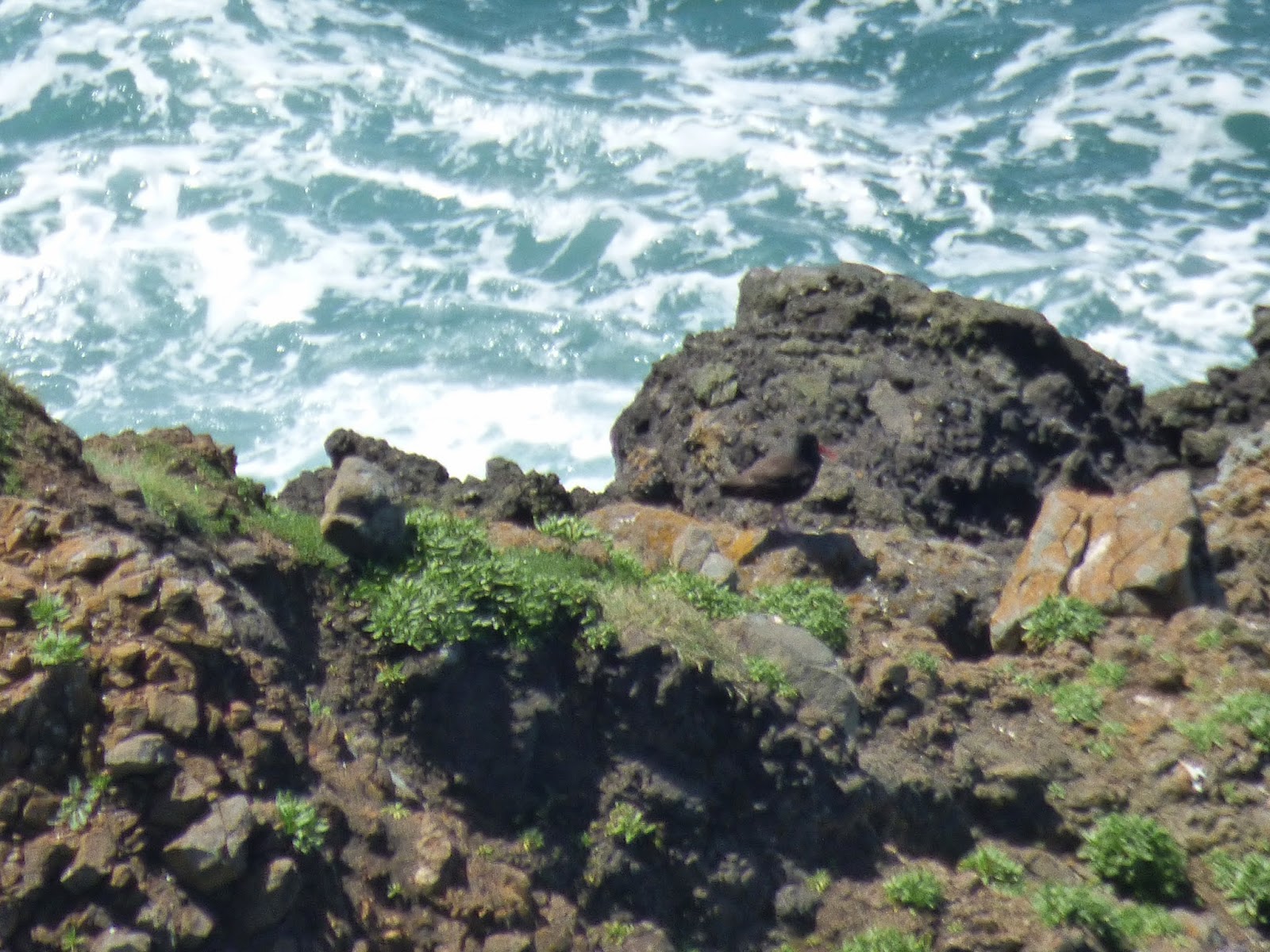

Here it is zoomed up in the camera to blurriness.


We were so intent on searching for these black birds with red bills that we did not notice the pod of whales going by until a teen-aged girl came rushing down toward us from the top of the Thumb hollering "Do you see the whales?!" We had not. They were cruising right below us, just beyond our BLOY nesting rocks. Johnny counted 5 or 6 adults and at least 2 calves. The girl and her friend were from the Outdoor School at Camp Westwind, just north of this promontory where we survey BLOY. I'm very glad they alerted us!


Gray whales go south in the winter to calve in warmer waters and then back north in the spring. The cows with calves tend to stay close to shore to avoid deep water predators, or so I've been told.

After the whales passed, it was back to BLOY watching. We soon saw a single bird on the northwest pair of Middle Rocks. They nest on the southeast rock but the one not on a nest often stands guard on the nearby rock, where it can see the nest area.
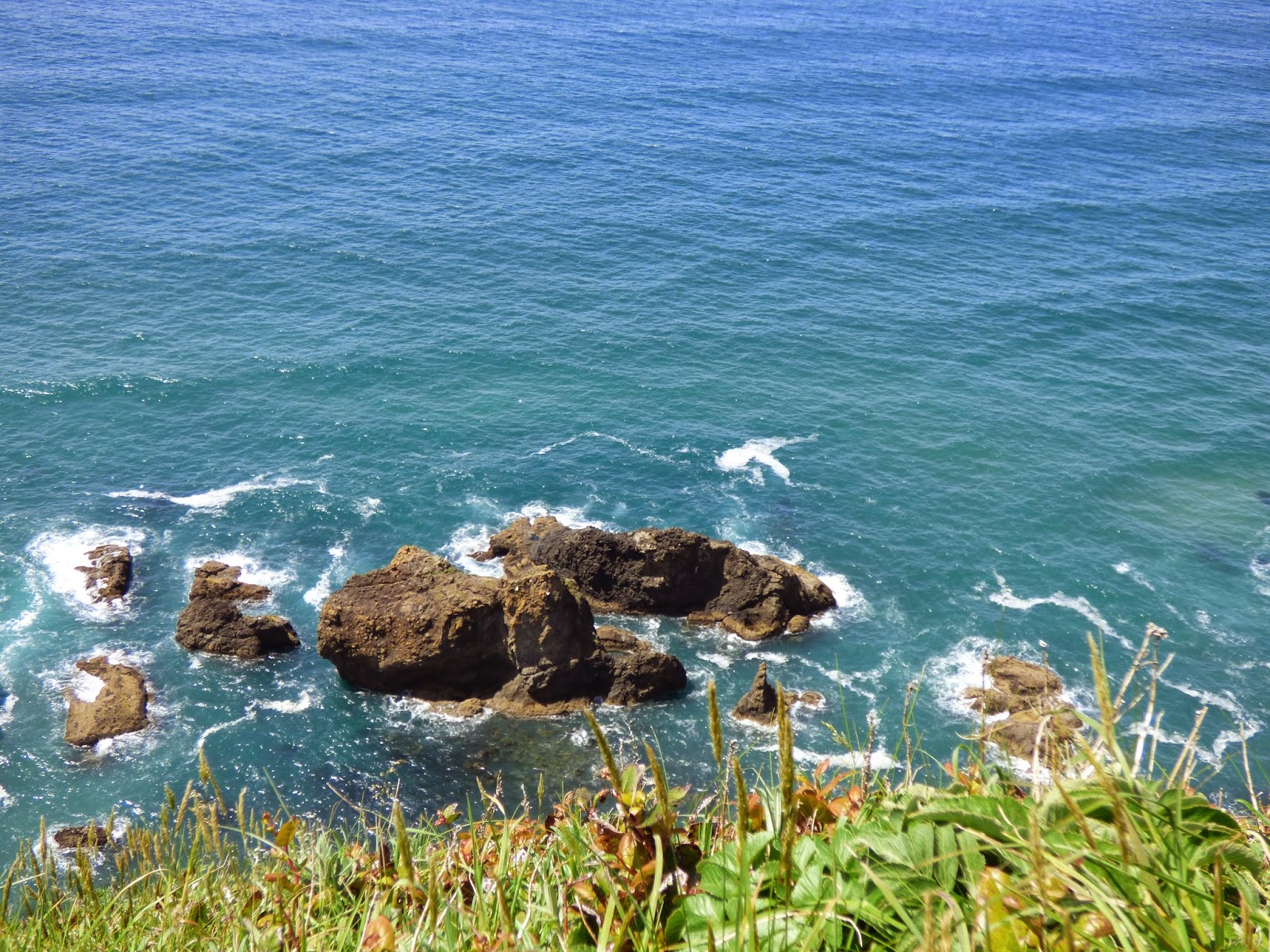
 Even though a BLOY is silhouetted against the surf in the photo below, it is very hard to pick out. When Johnny first spotted the bird, it was against those dark rocks.


Here it is zoomed up, right on top where they like to be. And where I like them to be so I can see them!


After we had watched nest exchanges on the Original Nest Rock and the Middle Nest Rock, and saw the North Nest Rock BLOY on guard duty, we packed up our gear and hiked back down. We had time for a mid-day snack in Pacific City and then a short side-trip to Cape Kiwanda.

We had seen a dead seal on the beach Sunday, during our BLOY survey there, which we thought was another Northern Elephant Seal, like we found on last month's COASST (beached bird) survey across the Salmon River. But we had taken no photos. We did that now and sent them to the beached mammal biologist at Oregon State who had identified the Northern Elephant Seal for us last month. He replied that it was a Stellar Sea Lion, probably long dead and decomposing before washing up on the beach. (The photos are too grisly to post here.)

It was still fairly early in the day, so we drove on to Cape Lookout to look for livelier creatures. We often see or hear BLOY there but have not yet located a nest. It is a very difficult area to survey because there is almost no visibility of the rocky habit Oystercatchers like. And it's a very long hike (nearly two and a half miles one way) on a path over tree roots to the tip of the cape. But it was a lovely day and I did not want to return home where it was almost certainly much hotter.

Here Johnny stops on one of the more civilized parts of the trail to admire the big trees.... or something. Or maybe he was just waiting for me to catch up.


 My method for surviving long hikes is to stop often and take photos of flowers... and catch my breath.

False Lily of the Valley: Maianthemum dilatatum


 Half way out to the end of the cape is a view of a rocky outcropping that I've always thought should have a pair of BLOY on it, but never has. Until this day. Almost too far to pick out with binoculars (and we had not brought a scope on the hike with us), two tiny black birds with red bills were standing on the rock. My camera was able to see them better than we could.


And my photo program brought them even closer.


Then it was more hiking to the end of the Cape in hopes of hearing or seeing more BLOY there... or more whales. Fortunately, there were more flowers along the trail to provide a bit of respite.

Indian Paintbrush: Castilleja sp.

What we saw all along the south side of the cape were huge and noisy rafts of Common Murres. There were thousands of them and their constant chatter sounded like angry cats fighting.


We neither heard nor saw BLOY at the end of the cape. No whales, either. But the view looking south toward Cape Kiwanda was lovely.


Zoomed up in the camera, the cape and the Rock looked much closer than they are!


The long walk back found more flowers, naturally.

Clasping Twisted Stalk: Streptopus amplexifolius 

Milkmaids:
Cardamine californica var. integrifolia


And then, just as the trail was about to enter the forest and leave the view of ocean, I spotted whales! While I tried rather unsuccessfully to get pictures of the whales so far below us, Johnny counted: 6 adults and 3 calves. We think it may have been the same pod we saw from Road's End, six hours earlier. This was the only smudge in the water more or less identifiable in my photos as a whale.


When we finally reached the trail head parking lot, we decided to drive the one mile farther to the only other place we have seen or heard BLOY at Cape Lookout. There are two large rock islands out in the ocean a long way and through many trees from this pull-out on the road, but with a scope we had seen BLOY there a few times in past years. We did not see any this time, as we peered through tree branches at rocks a very long way away, but we did hear one. By then it was 8:30 at night! So we headed home.

Our "easy, restful" plan to survey just at Roads' End had morphed into one whale of a day.

Wednesday, May 14, 2014

Marathon Mother's Day Weekend


 After the scare last week from son Steve's sudden excruciating abdominal pain that landed him in the hospital for two days down in California, I was ready for some stress relief. Steve and Munazza called Friday night and Steve seemed to be recovering, although the cause of his pain was never diagnosed. We continued with our weekend plans, cell phones with us.

The North American Migration Count is always the second weekend in May: Mother's Day weekend. I look forward to birding our farm for the Yamhill County portion of the count, plus up Agency Creek. We combine the count with surveying Dippers along the six mile stretch that I've adopted for my survey.

I walked around the farm at first light, listening to the dawn chorus of bird songs and trying to separate them out. The Ruffed Grouse drumming in our woods was obvious. I also tried to get a few photos of birds on our farm in the early morning, but it was foggy and the birds not terribly cooperative. Later, when the sun came out, this American Goldfinch insisted on hiding behind branches.


A very rufous Rufous Hummingbird was up in plain sight, but the lighting was difficult.


After morning chores we headed up Agency Creek Rd. and our first Dipper nest site, which entails a long hike through the woods. In the deep, damp shade we found these Western Coral Roots, a native orchid.


Spotted Coral Root:  Corallorhiza maculata
We didn't find Dippers at that first site, but we did hear two different Ruffed Grouse drumming. And lots of warblers. I was calling some of them Black-throated Gray Warblers but wondering if I was correct. Then one came into view and as I watched, opened its bill and sang the song that I'd been hearing: "busy busy busy busy WE saw". At least, that's what the Black-throated Gray Warbler's migration song sounds like to me.

Black-throated Gray Warbler

We saw a Spotted Sandpiper at the gravel quarry ponds. They are said to be common around streams and lakes everywhere but I rarely see them. It was too far for a photo but we came back after the weekend: the bird was still there and I managed this photo.

Spotted Sandpiper
At the second Dipper nest site on Saturday, we lucked into seeing a pair of Dipper fledglings being fed by a parent.

American Dipper fledglings waiting for food

Parent Dipper delivering food to open-mouthed fledgling

Calling and batting its wings for food
 Although we saw a total of seven Dippers on count day, those were the only ones we photographed. Mostly, the flowers stood still better.


Aquilegia canadensis   
Wild columbine
 
Maianthemum racemosum  False Soloman's Seal


Polk County migration count is on the same day as Yamhill county, so after leaving Agency Creek, we drove to nearby Shenk's Wetlands in Polk county and counted birds there, including two White-tailed Kites. By then we were hungry, so went to Willamina's Wildwood Cafe for supper.

The next day, Sunday, was the Tillamook county migration count. We combined our Black Oystercatcher survey at Cape Kiwanda with that count. Those wonderful black birds with the long orange bills were right where they usually are at high tide, resting on the side of a cliff.


Johnny hiked on out to the very end of the cape and peered over the edge at the rocky ledge below. He spotted two Ruddy Turnstones. (No, he didn't know what they were but he found them in our bird book.) I eventually worked up the courage to go out to see them and take photos. They were a long way away and well camouflaged at times. Believe it or not, both Turnstones are in this photo.


Here is one visible. The second is just below it and to the right. Look for the orange leg.


Once in awhile, a Turnstone cooperated by choosing a contrasting background.


Two Black Oystercatchers were down on these rocks, too. We were not sure if they are the same two that might have flown from the cliff or a different pair. There are two pair that nest on Haystack Rock and feed on Cape Kiwanda.


On the north side of the cape, a hang glider was enjoying the lovely weather in his own way.


From Cape Kiwanda we drove to Whelan Island to add birds to the Tillamook count. It was a beautiful walk through a forest of blooming rhododendrons.


The butterflies were enjoying the rhododendron flowers, too.


Western Tiger Swallowtail   Papilio rutulus

A Rufous Hummingbird showed off his brilliant gorget.


We did not want to go back to crowded-on-Mother's-Day Cape Kiwanda for supper, so we drove home via Cloverdale, where all the cafes were closed, finally settling for an ice cream cone in Hebo and supper at home.

It was an exhausting weekend, but fun, greatly enhanced by hearing from Steve on Mother's Day morning that he was feeling fine.


Sunday, May 4, 2014

Spring Projects

To prove that I don't just wander around the farm taking photos of flowers and birds, here are a few of the projects that I've been spending most of my time on.

A big one was clearing out the winter-killed bamboo from the too-thick clump behind our house. The new shoots were coming up so I needed to clear the dead canes out before the new ones made that impossible. The clump looks bare now, but it won't for long!


I should have taken a photo of my many piles of bamboo stakes, sorted by length. The short ones are plant stakes for the garden. Then come the tree stakes of various lengths and finally the tall gourd nest stakes. Most went into the back of the carriage house to await use. But the smaller ones for garden stakes live in the garden shed. I had to clean out the old garden stakes to make room for the new ones. That led to cleaning out the whole disastrous mess of a garden shed. I did not take any before pictures because it would be too embarrassing. Now everything is organized... or everything that's left: we tossed a lot of stuff!


Johnny tilled the garden and I have planted a few things, not yet up. Earlier I planted potatoes in the old manure spreader. They are doing well.


I also planted lots of early seeds in raised beds: I don't try to fight the gophers for root crops. Here are radishes and beets coming up in one bed. Johnny made the openings to fit window screens so the plants get a head start on birds and chipmunks.


The onion sets are growing fast. I just yesterday interplanted them with carrot seeds because I was running out of room in the other boxes.


Of course, I do still find time to take photos of birds and flowers.

The hummingbirds are back after wintering in southern climes.


The Golden-crowned Sparrows that winter here were still here a few days ago. Then, quite suddenly, they were gone...  


 ...replaced by summering White-crowned Sparrows.


The California Quail are all year residents.


Each day, it seems, new flowers open in the beds so, of course, I have to preserve them in pictures.

The peonies are just beginning to bloom.


Along with purple and white iris.


Upstairs, by the computer, the Hoya is dripping its sweet nectar all over the floor.


And in the greenhouse... well, I'll save those flowers for another blog entry.


It's a busy time on the farm, but never too busy to notice birds and flowers... and take their pictures.