Sunday, May 9, 2021

A Happy Mother's Day

 My Mother's Day request was to drive up Agency Creek Rd. and look for American Dippers at their nest sites. We did and we found them! 

But our first stop was not at a Dipper nest area, but at the old rock quarry where we often find interesting water birds and, once, a Dipper. Johnny spotted a weasel there once, too. This time he found the first ever Belted Kingfisher nest hole that either of us had ever seen. He saw the bird fly straight into it and not come out. We were astounded that it was practically at the top of the cliff. We had no idea Kingfishers would nest that high but I guess it's pretty safe from pretty much everything and the creek for finding food for the nestlings is close. I kept watching and finally the Kingfisher flew out and toward the creek. Of course, too fast for my camera. I have since researched and learned that these amazing birds dig their nest burrows 1-3 feet from the *top* of a bank and the nest tunnel is 3-15 feet deep! If you enlarge the top photo, look for the white splash below the hole that is on right side of the bare section of cliff, just below the greenery... maybe 3 feet from the top of the cliff.


While waiting for the Kingfisher to reappear, I took a photo of rocks reflected in the pond that sits at the foot of that cliff.

But I was impatient to find Dippers so we drove on. Our first Dipper related stop was at The Chutes, which is usually a raging torrent covering a wide shield of rocks this time of year. Only in the driest part of the summer does it become a roiling, narrow chute of water. But now, in this incredibly dry spring, the river is as low as it is normally in August. We found no Dippers there (the nest is a distance downstream but the Dippers often forage at The Chutes.) We did see a lone female Common Merganser in the pond below.


Next was the first of several bridges where Dippers have nested in the past: the Railroad Bridge (bridge for vehicles but made out of a railroad bridge). A Dipper sat motionless on a rock in the middle of the stream, very close to the bridge. We did not disturb it by hiking down to peer under the bridge. 


Just a half mile upstream is Sharkey's Bridge (I don't know how it came to be called that by the locals). This one appeared to have a lot of older guano spots on rocks near the bridge so I climbed down the bank and peered under the bridge. To my surprise, a Dipper was sitting on the bare underside holding very still. I quickly left.


.


 The next site is what I call Singing Rock, because for years I would hear a Dipper singing in that area but could not find it. Finally a couple years ago, Johnny spotted a Dipper flying into a mossy nest in a fern and log shrouded bank. Today, Mother's Day 2021, two parent birds were busily feeding their noisy and demanding children.


Next stop, Asinine Bridge, so named because it curves the wrong way for the cliff... an engineering error. The mossy nest is quite visible from the road if you know where to look and have a good pair of binoculars as it is well hidden.
 

If you zoom the photo in, you may see the nest in the center of the photo left to right and about one third of the way down from the top.

 
The nest!


 We did not see activity at the nest site but Johnny spotted a Dipper flying upstream.
 
The last nest site is under the last bridge. Paul Sullivan had seen nest building activity here on April 15 and I did find a nest but no birds in view. I did not linger as this pair tends to be the most people-shy. 


A Kingfisher nest hole and Dippers galore. What a great Mother's Day!

Thursday, May 6, 2021

A Long Hike

On May 5, Johnny and I hiked a trail I swore I would never hike. It is one that goes to The Thumb, where I have monitored Black Oystercatcher nests on offshore rocks for many years. But the trail I took is now closed to the public. The new, longer version is advertised as a tourist hiking trail, rated "difficult". It began as a trail to The Knoll but now few people take the side trail that goes to The Knoll. The Thumb is more popular.

 Another BLOY (Black Oystercatcher) monitor took over last year but because of Covid and a narrow trail, she only went two times. That wasn't enough to know the outcome of the one nest we both knew was there. So I vowed this year to go via the beach into the cove below The Thumb when tides were low enough. And I have, twice. Last week I was sure the pair of BLOY who were hanging out on that nest rock the first week were nesting last week, but from below I could not find the nest. 

So Johnny agreed to go with me yesterday, May 5, to keep me from getting lost. We read the directions online and studied the map and drove to the designated starting point at the cul de sac at the end of NE Devil's Lake Blvd. It turned out to be a very long, arduous, up and down hike. But we made it. And soon, so did a lot of other people. The Thumb with its spectacular coastline scenery is a popular hiking destination now. 

From up there, it was easy to find the nest... in the same place it has been for several years. And the BLOY kindly did a nest exchange twice, 50 minutes apart as is their usual, and we were able to see three eggs. Hallelujah! 

But I'm not doing that hike again. I hope the new monitor is able to go more often this year. She is several decades younger than us (probably four or five decades younger), but has the disadvantage of working during the week so has to go on tourist-busy weekends when the trail and the top of The Thumb are crowded. Here's our trek in photos... 

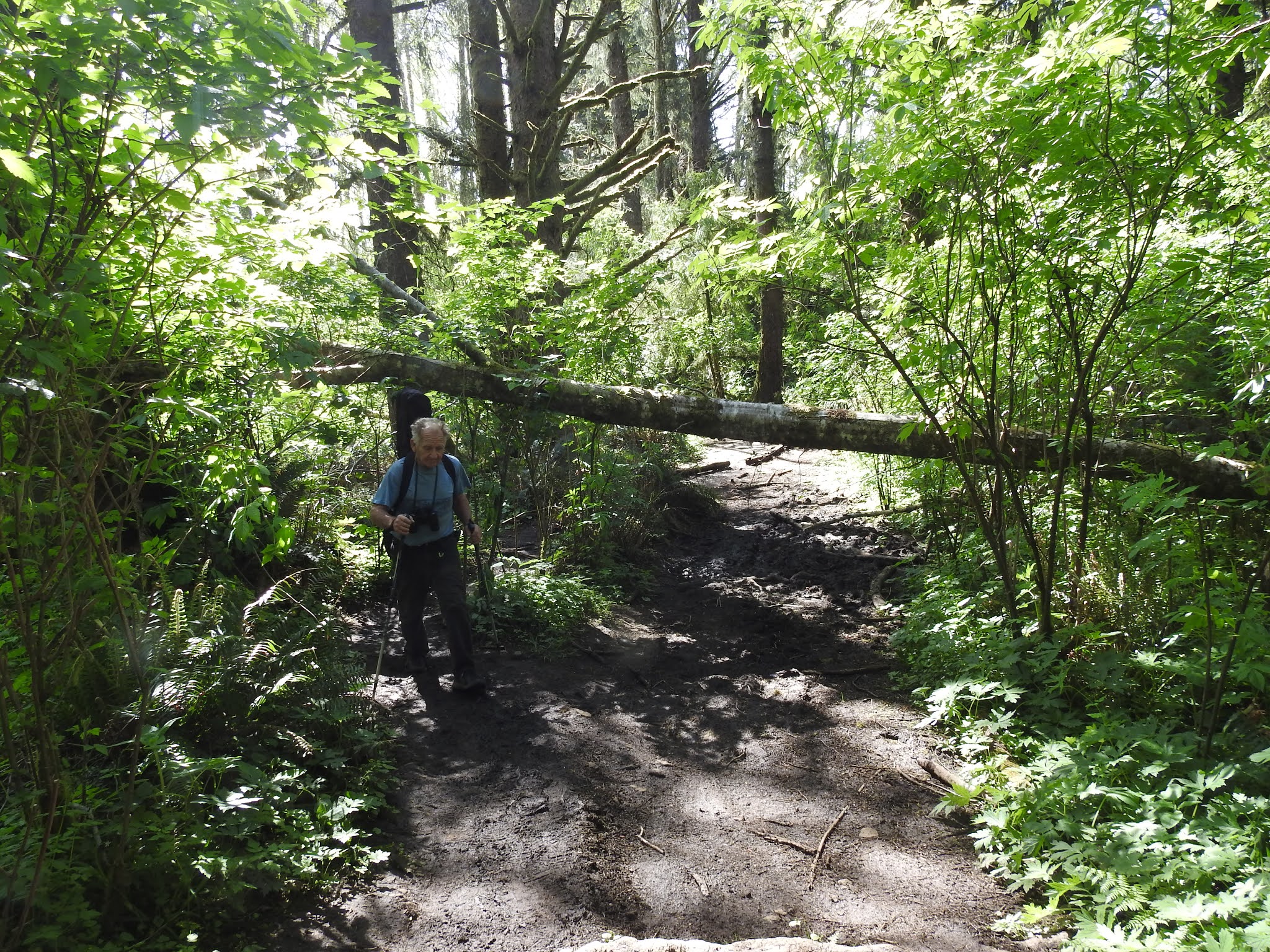
 The first photo is the climax of our trip: the BLOY returning to her nest of 3 eggs. Then the photos proceed in order along our hike, showing some of the several huge widow-maker trees leaning over the trail. We finally break out into the meadow on top and then the amazing views. And my much-loved views from the very edge of The Thumb, looking down at the nest rocks and beyond to the distant island, which this day had a mature Bald Eagle on top and a younger one partly down the side. The sign photo was taken on our way out and was apparently erected when this trail was only for The Knoll. 


This view of the Oystercatcher returning to her nest of 3 eggs made the trek worthwhile!


Our first view of the ocean peeking over the meadow


Johnny at the top, looking toward Cascade Head. He carries our small scope in a guitar case on his back


Looking south along the Road's End coastline


looking north toward Cascade Head


The Thumb in the distance. Just one more treacherous cliffside trail between...


Looking down from the trail toward the foraging rocks where we often see BLOY
A closer view
Johnny on his final ascent up The thumb
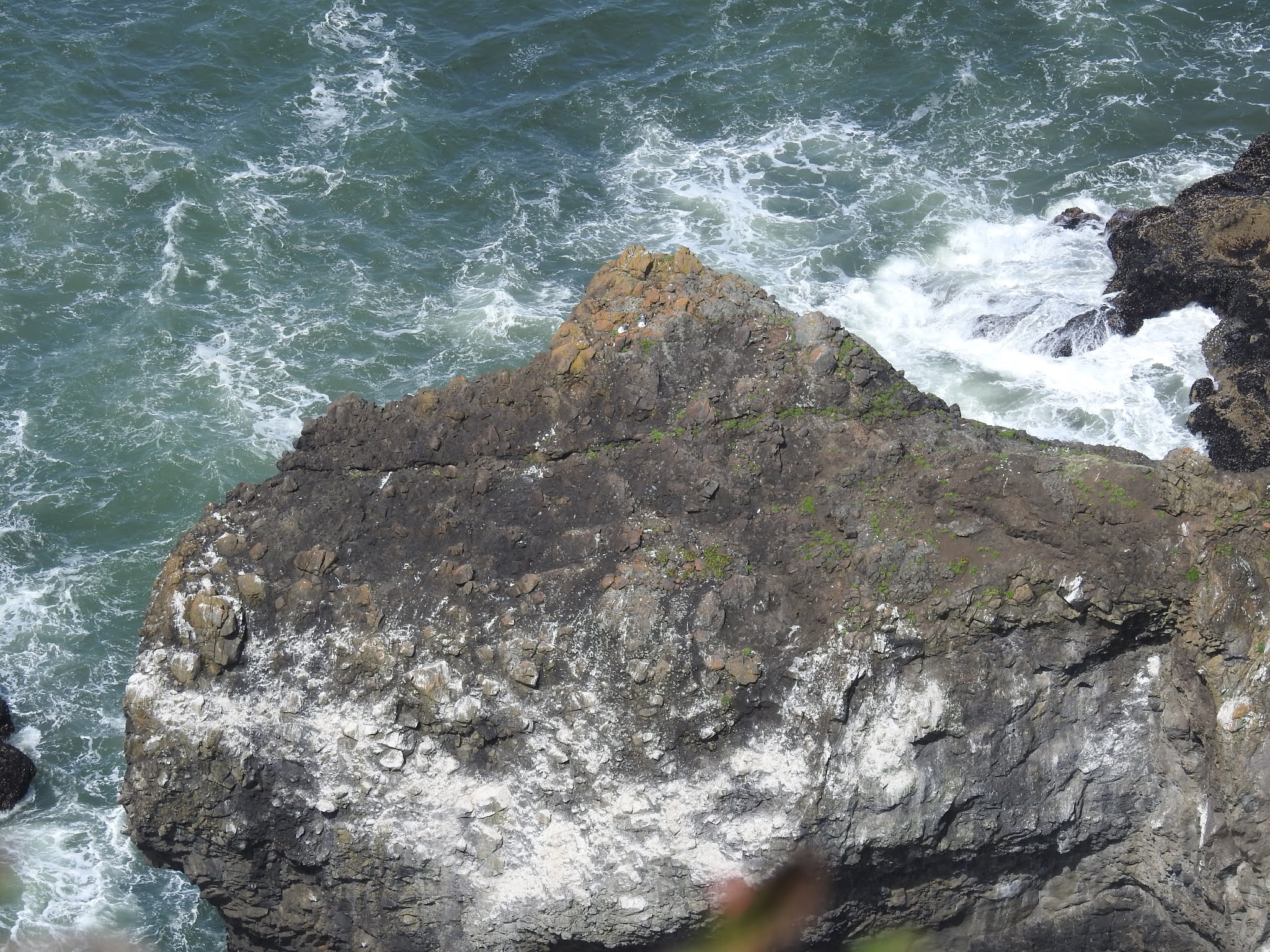
This is the view from the west most point of The Thumb, where I sit to monitor the nesting birds. The Middle Rock, with the nest, is the white-washed rock in center of photo
The nest is straight down from the highest point of the rock. The two white spots are gulls.
Straight down from the gulls, below the horizontal cleft in the rock, at the bottom of this photo is the nesting BLOY
Here she/he is returning to the nest of 3 eggs
back on the nest
The view of another nest rock, foraging rocks, and Polly Island in the distance
the island, devoid of its usual hordes of cormorants and gulls
On the very top of the rock is the reason for the lack of seabirds
A Bald Eagle!


Down and to the right is an immature eagle


Monday, May 3, 2021

Exotic Orchid and More

 In February, I noticed something coming out of the bottom of the big hanging basket orchid I inherited from friends Barb and John Woodhouse when they moved to Minnesota to live with their daughter. They could not take their orchids with them so gave them all to me. Many have bloomed but this big-leaved orchid in a moss basket, hanging from the ceiling of our jungle room, just grew roots out the bottom of the moss but no flowers. I was told the flower stalks begin at the base of a leaf.

At first, I wasn't sure if this was just more roots or what. It took forever to finally start looking like it might have buds. The buds developed slowly and began opening a few days ago. Today they were all three fully open and very fragrant. Stanhopea embreei is a very strange and exotic plant. I am so grateful to have been entrusted with this plant. Barb lived long enough to see many of her orchids blooming in our house (I sent them photos) but she passed away this fall before this mega orchid bloomed. John and his daughter Veronica get my photos now. I think it bloomed for Barb and John many times by the look of all the spent buds hat hung underneath it when we brought it home. So maybe it will bloom again for me!


April 23


April 26


April 27, definitely buds!


the orchid cactus want to get in on the show, too


And the babaco papaya!


This little orchid opened its first bud on April 20


On the kitchen window sill, it opened it's second flower finally on May 2nd


But none of those could outshine the Stanhopea when the three buds fully opened, filling the greenhouse with their fragrance, on May 3rd.


No matter how you look at them, they are strange! And worth waiting for.

Saturday, May 1, 2021

No Rest for the Wicked

 Johnny and I must be very wicked because we sure haven't had much time to rest. Johnny, especially, is a workaholic. He is out mowing places with his push mower right now where I cannot get with my ride around mower. He spent months clearing the ice storm damage and even opened up the main trails in the woods that had been completely blocked by downed trees.

And he has brought many loads of compost to the garden after I dumped many loads of horse manure on it. Then he tilled it all in over and over and over. Meanwhile I transplanted tomatoes from their flats in the greenhouse into pots, then yesterday moved them into the garden tires. I'll wait for warmer weather to plant corn and other warm weather crops. 

The raised beds have lots of volunteers from last year plus new I planted recently. Parsnips have moved themselves all over the place and we eat them often. For so many years I couldn't get parsnips to grow: now they reseed themselves everywhere.

Daffodils have finally mostly given up. Until now I have deadheaded them daily. We have a lot of daffodils. They spread like wild things. I have planted new trees in various places, and then had to water them since our weather has not been its usual April drippy. Johnny got a load of barkdust and replenished our paths. I stole some to mulch my new trees.

In this strange weather year, burning was not allowed for weeks so when we finally got a little rain and burning was again allowed, Johnny lit his two enormous piles of debris he'd collected from the February ice storm. It was a perfect weather day for burning with no wind and the piles burned fast and well. That was a relief.


Here's what one pile looked like before the burn...


 This week Johnny worked at getting the downed and broken pines out of the ponderosa pine grove in the arboretum. I helped one day hauling stuff to a new burn pile in a different field. We also now have a huge amount of pine logs for firewood. We will never run out of firewood again.

Occasionally, I sneak off to the coast for bird surveys. Most recently, I scouted for Black Oystercatchers at Road's End. Those stories with photos here: https://bloymonitor.blogspot.com/2021/04/2021-roads-end.html and here: https://bloymonitor.blogspot.com/2021/04/2021-roads-end-revisited.html

In bird excitement at home, the pair of Kestrels that nested last year in the South field nest box, have moved their operation to the nest box in the hay field next to the arboretum... visible from our kitchen window! Here they are before she started setting on eggs, which she apparently has done now.


 And today, when the male apparently brought something to the female inside the box.


It will be fun to have a closer way to watch the nesting activity.

Lots of flowering in the greenhouse which I will save for another post... when I need another excuse to sit down and rest.