Friday, August 19, 2011

Night Blooming Cereus

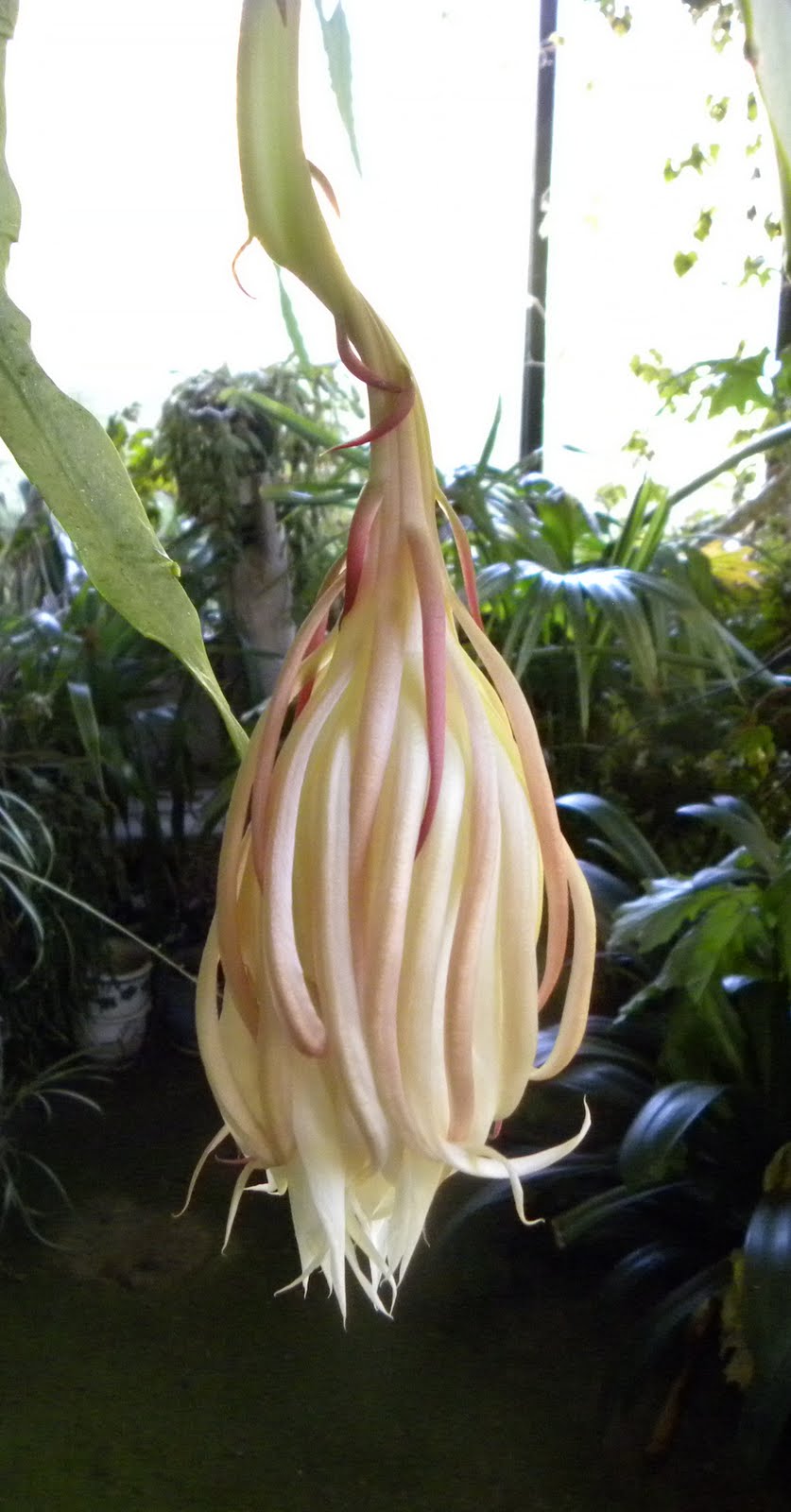
These jungle cacti hang from the balcony in my jungle room (attached greenhouse/solarium) and bloom in the summer. At night. For only one night. Usually when I'm out of town.

It is difficult to keep remembering to check them daily for buds, then to keep checking as the buds grow. They grow fast. And very sneaky. As long slender addenda to the elongated stems that serve as leaves, the buds are anything but obvious. And they hide behind the other foliage in my jungle room. Then, without warning, one night they open and emit the most intoxicating fragrance. It's their one night to attract a moth to pollinate them. They are out of luck in my jungle room but they try anyway.

The photo below was taken as the bud began to open, 9:15 p.m., last night.


Here it is almost fully open 45 minutes later.


I was too tired to stay up for the ultimate opening. The photo below was taken at 8:30 in the morning. The show is over.


At 5 the evening after (I just took the photo below left), the drooping flower still has beauty, in a way, but no fragrance. The first bloom on this plant bloomed two days ago... and I missed it. I usually do. The flower gradually gets more droopy, then turns black, as the ric rac cactus bloom on the right did. The ric rac also blooms one night with a flower almost identical to the cereus... and even harder to find because it hangs from the ceiling. I did not see this ric rac bloom until it looked like it looks now... black. Very frustrating. However, last year I did see blooms and they did not look like the ric rac blooms in the books or on the web, which are red and white. They looked like the cereus, all white. So I suspect my ric rac is a type of orchid cactus masquerading as a ric rac. Who knows. It starts making lots of buds but they almost always turn black before getting any size. I don't know why. The Night-blooming Cereus does not have that problem.


The middle photo above shows the cereus amid the other jungle cacti. The spent bloom is bottom right of that photo. Below is a shot of the ceiling showing the ric rac cactus. The spent, blackened flower is lower left. The leaves in that photo that are not ladder-like are cereus leaves. It is walking across the ceiling now, too, no doubt preparing to flower where I have to break my neck to see it. You can see why Johnny calls this my jungle room.


In July of 2009, the cereus outdid itself with at least 7 blooms. I don't remember how many I saw open. Probably not many. The photo left from 9 p.m., July 15, 2009, shows five spent blooms and at least one about to open (very bottom of the plant). Photo right shows one open at 6:45 the next morning.


It's a spectacular flower, huge and wonderfully fragrant. Maybe if I threw my sleeping bag in the jungle room, I'd be able to watch the whole show. Presuming I had remembered to check each evening to see when a bud was beginning to open.

Thursday, August 11, 2011

New Blog, New Routine

Since this blog was begun as... and has continued to be... my journal, I've started a new one about, mostly, birds. It is called, at the moment, "Birds". Appropriate, yes? It came into being when a bird I couldn't identify showed up in front of the barn one morning. I took lots of photos. Then I needed a way for crack birders to see the photos and identify the bird for me. It seemed difficult to upload them to one of those photo sites, but I know how to upload to this blog site... so I did.

Lots of birders did, indeed, look at my bird and tell me it was a juvenile Chipping Sparrow. If you're curious what a juvenile Chipping Sparrow looks like, check out my new blog: http://lindafink-birdnotes.blogspot.com/

Then it occurred to me that I could upload more bird photos, since I seem to take many that don't really need to be in my journal. Ergo "Birds" has become a repository for bird photos I don't want to lose in the depths of my computer. One of those, in particular, I am quite proud of, so will share it here, too. I took this photo of a Great Egret at Baskett Slough National Wildlife Refuge, which is a place I visit often... since it's on my way to the feed store. Great Egrets are common there this time of year and pretty oblivious to humans snapping pictures of them.


Besides a new blog, I have a new routine as long as the days are hot (anything over 75 is hot to me) and as long as the baby goats are drinking all their moms' milk if the moms are not locked away from them. New routine: I get up early as always, feed horses and chickens and (this is the new part) milk goats. I used to feed horses and chickens then go back into the house for breakfast before meandering out to the goat barn. But now I'm having to lock the does away from their kids at night so we and our customers can have some milk. That means full udders in the morning... So, after horses and chickens are fed, I milk the goats... before their cries of indignation set the Big White Dog to howling. Then I turn the does back in with their large children who don't need all that milk.

By this time, I'm hungry and retreat to the house for breakfast. After breakfast, I let horses out, clean barns and feed hay to the goats. By then it's hot. So I go back to the house and... here I am, typing out a blog post instead of getting more work done. My plan is to ride a horse or two before lunch (I rode two yesterday) but if it's too hot (or I'm too lazy), stay in the cool house and Get Things Done. Or take a nap. Or write a blog. Late in the afternoon, I go back outside to weed, water, mow (or ride horses).

Of course, routines are made to be broken and this is horse hoof trimming time of the month so this morning, after chores, I trimmed Nightingale's hooves. That left me too hot and tired to ride Mr. Smith, as planned, before lunch. (I'm too wimpy to trim more than one horse per day.) Maybe I'll revive and ride this evening.

For those reading this who are also too tired or hot or wimpy to get anything done, here is a fascinating blog with lots of photos of an adventuresome 25-year-old who is currently hiking the entire Pacific Crest Trail from the Mexican border to the Canadian border. He crossed into Oregon yesterday. Noah Stryker is an Oregon birder who has blogged previously about his Antarctic penguin studies (his book about that experience has just been published) and his Australian Fairy Wren research. Noah has packed a lot of living into his 25 years with no signs of slowing down. http://noahstrycker.com/latest/

And now, since everyone tells me they like the photo part of my photo blog the best, here is a butterfly on a daylily at our farm, adding beauty just by living, totally unconcerned with goats or horses or blogs or new (or old) routines.


A Visit from Junkman Jeff


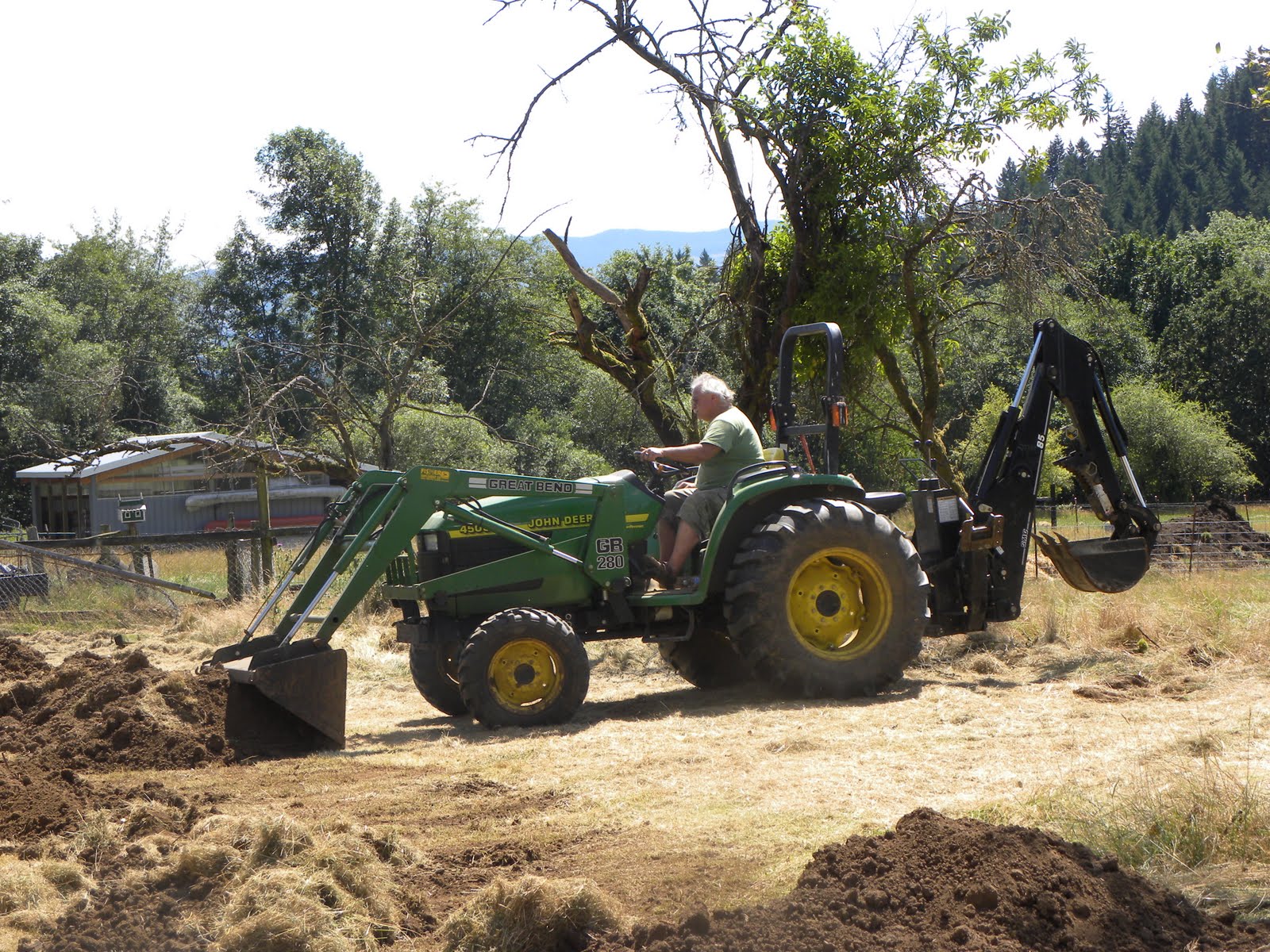
Johnny's nephew Jeff from Illinois spent three whirlwind days here last week mostly digging a trench from shop to new goat barn for the electric line. "Junkman Jeff", as he likes to be known, is good at driving big machines. He put the backhoe on Dad's tractor to dig the trench, then filled it back in with the bucket of the tractor after the pipe was laid. Johnny was happy to get so much work done in so little time but he sure did get worn out trying to keep up with Jeff. The trench went through several goat and llama areas so many fences had to be taken down and then re-erected and animals temporarily relocated.


Now Johnny is working on finishing the project by connecting the wire to a new circuit box in the shop. Six weeks after his back surgery, Johnny is out of pain, regaining energy daily, and eager to catch up on the many projects that have been on hold for months. Jeff jump-started him, I think, and he is off and running.


They did take a little time from work to deliver milk for me to Oregon Wildlife for a Cuvier's Gazelle baby. Jeff and Johnny both liked seeing the two White Rhinos, my nemesis during my winter raptor run (story on a Dec. 09 blog: "Excitement on the Raptor Route"). The rhinos are now in separate fields, having decided this summer that they don't like each other. Two fighting rhinos are not fun to have around so each is going to a new home in animal parks far away.


Jeff liked the gentle giraffes, too. So do I. Much better than the rhinos. The photos at Oregon Wildlife were taken by Johnny.


Jeff was here last January for two days of fun described in my blog "A Visit from Jeff Fink". I guess he wanted to come back and work for his keep this time. Johnny certainly appreciated the help. Besides the trench, Jeff fixed a hose reel, helped Johnny put the new part in the electric golf cart so it runs again, and generally made himself useful. A nice guest to have.

Thursday, August 4, 2011

Hart's Cove

My weekly visits to Black Oystercatcher sites on the coast are basically over, all nests having failed either before eggs hatched or after chicks appeared... and disappeared. I'll look again in a few weeks in case the missing chicks reappear, but no more weekly visits to my assigned sites. However, there are other sites in my area that do not get regular coverage (being ridiculously hard to access) and I hiked one of them today.

Hart's Cove is a 2.7 mile mostly steep hike... to the meadow. From there it's another who-knows-how-long hike down the also steep "meadow", today covered with over-head-high thistles, to where the offshore rocks, potential Black Oystercatcher hangouts, can be seen. I am running out of hiking companions willing to wear themselves out for the cause, but Nancy volunteered. She had not hiked with me before and I was afraid never would again. But the weather was lovely and she a better hiker than I. She says she's up for the next round.

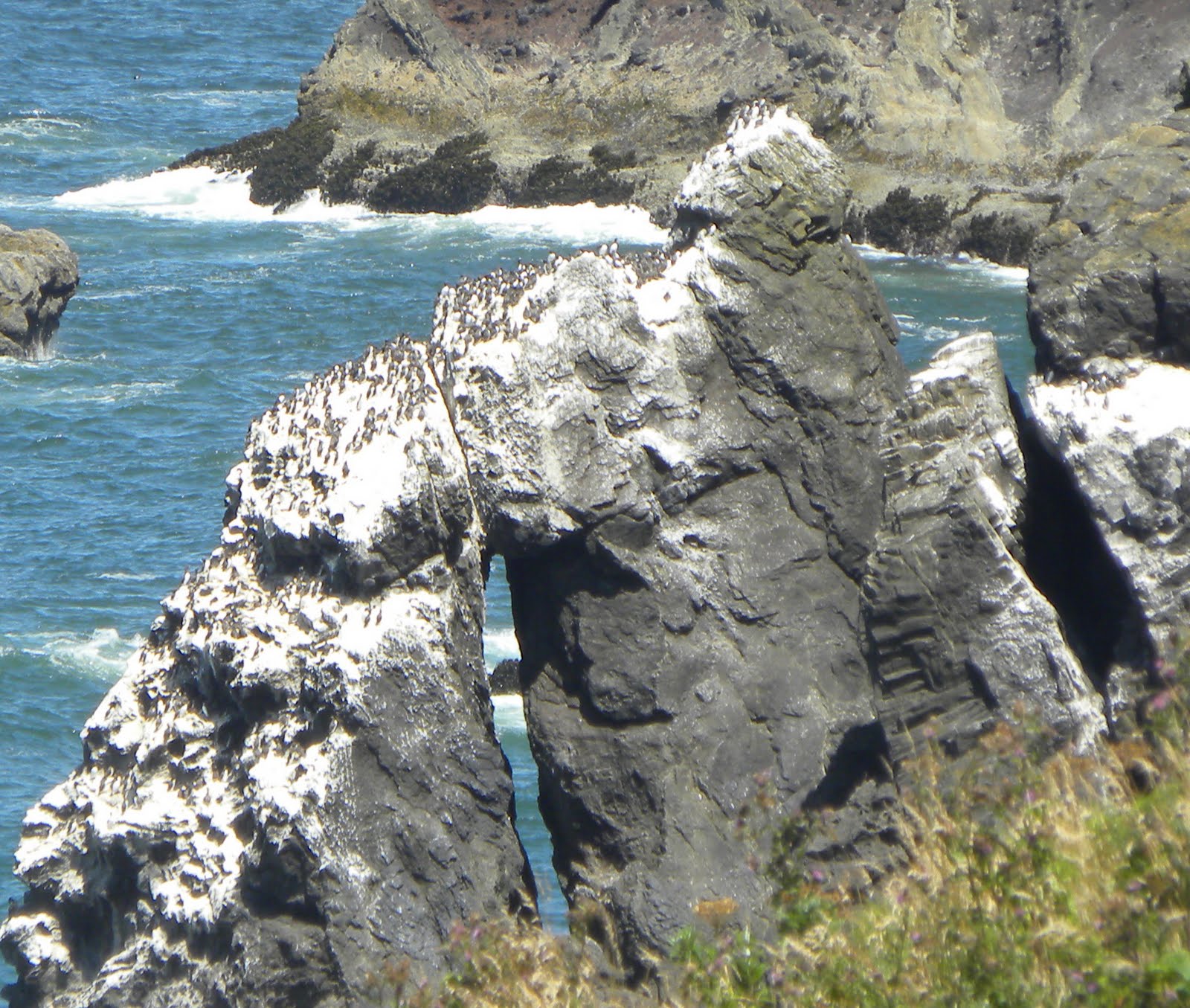
The view when you finally get to where there is a view, is spectacular. Sea lions line the rocks, some with young ones this time of year. They are quite noisy but it takes a scope to see them well. I hauled my new scope all the way there just so I could scan the more distant rocks for Black Oystercatchers, which I did not find. But we did see Sea Lions up close with the scope. Then we hiked to the base of the meadow where the offshore rock that BLOY used to nest on is visible. Nothing but cormorants this time. We could also see a large whitewashed rock to the north covered with Common Murres (and Common Murre guano.)

It would be nice to sit and watch the Brown Pelicans and Pigeon Guillemots, Sea Lions and other denizens of the sea for hours. But it's such a long hike in and an even longer one back out (out is mostly uphill), we did not stay long. Nancy, among the dried grasses and weeds at the foot of the meadow, enjoyed what time there was to sit and relax.


The trail as far as the meadow is well maintained, although this time there were a few more trees down across the path. Big trees. Huge Sitka Spruce line the trail.


This is a research area, so things are allowed to do what they would naturally do. Rotting snags are dotted with shelf mushrooms. This lovely orange fungus was alongside the path.


The sign at the trailhead has always made me laugh. "The first half mile of the trail is rather steep" is a bit of an understatement. This time, a more realistic notice was tacked on "CAUTION... DIFFICULT HIKING CONDITIONS". I rested against the sign at the end of the hike, tired but triumphant. Two old dames that we are, we made it!


Saturday, July 30, 2011

Birds, Butterflies and Blueberries


All those California Quail that hung around here last winter getting a handout seem to have paired up and produced more little mouths to feed. We have at least two and probably many more quail families... mostly in the driveway. They seem to love to dust bathe and peck at who-knows-what in the gravel. I gave Johnny and grandson Ian, when he visited, the job of creating a sign to put at the head of our driveway to make sure visitors drive slowly and watch for the wee birds. I think it has helped. At least, I haven't seen any squished quail.

These little guys are about twice as big as when I first saw them. But they are also fewer. The original fourteen fluff balls in one group and eleven in another are now, apparently, nine and six, all feathered.


A pair of Eurasian-collared Doves, those invaders from across the Atlantic that are increasing rapidly and have reached the west coast... and our farm, have taken up residence in the barnyard and seem very tame. A pair of Mourning Doves hang around, too, but are not nearly so fearless. Yesterday, only one EC Dove appeared in front of the barn for the daily grain handout... and it was followed, literally, all over the lawn, by one Mourning Dove... an odd couple indeed. Note the size difference. The Eurasian Collared Dove has a black collar. The trailing Mourning Dove has a longer, pointed tail and black spots on the wings.


Today a pair of EC Doves came without the Mourning Dove. Maybe one of these days we'll have baby doves, of one kind or another... or both, joining the throng in front of the barn each morning.

Besides birds, we have butterflies. This one landed on a daylily today while I was mowing, giving me an excuse to stop and grab the camera.

I had another mowing break that was not planned. My mower grabbed the netting I have over a blueberry plant to keep birds and deer away. Alas, the blueberries came flying off with the netting. Other than losing nearly all its blueberries, ripe and otherwise, the plant survived without much damage. In the spirit of making lemonade out of a lemon, I ate all the ripe blueberries that had been ripped off. Delicious. I don't suppose the unripe ones will ripen off the bush, but I brought them into the house just in case they do.

Maybe I should have Johnny make a sign to put in the blueberry patch: Caution! Netting on Blueberry Plants!

Tuesday, July 26, 2011

July on the Farm

I always forget how busy summers are. In my head I imagine the long, lazy days of my childhood summers... riding horses, waterskiing, swimming, fishing, going camping. At least, that's what I remember. My mother would probably remember those days as filled with gardening, washing lots of filthy clothes, fixing meals and trying to find a few minutes to take it easy. Those are things I've been doing, along with milking goats, cleaning barns, mowing and weeding.

Summers also invariably include company. Our 9-year-old grandson visited last week. My work was happily interrupted by riding horses, canoeing and hiking the beach with him. Johnny enjoyed time spent with Ian, too. Together they canoed, plumbed the new goat barn, watched videos, and played in the sand at the beach while I looked for Black Oystercatchers ( my continuing once a week activity).


We returned Ian to his parents at the big Dressage at Devonwood horse show last weekend. For three days we enjoyed friends and family and beautiful horses... between morning and evening chores. The weather at the show was lovely, particularly the first two days when it was clear but pleasantly cool. The grounds at Devonwood Equestrian Center are spectacular. Here is Jessica's horse Rudi with his trainer Nicki Grandia in the warm-up ring, Mt. Hood in the background.


And here is one of Nicki's clients, Katie Newbury, on her beautiful Friesian gelding Joe, being escorted by some of the Traumhof team and their supporters, including Kevin and Ian and Johnny (Jessica and her sister Sarah are hidden behind the big black horse). Joe was high point Friesian at the show. The Newbury family along with all the other members of the Traumhof team were very supportive of each other and a lot of fun to be around.


The downside to the show was Kevin's chest pains that scared us all but turned out not to be a heart attack, but muscle spasms from some yet-to-be-diagnosed problem with his esophagus. Here's hoping it's easily and quickly fixed.

Now I'm back to watering, weeding, hoeing, mowing, washing lots of filthy clothes, and today: picking and freezing peas. Strange to be harvesting peas at the end of July but that's the strange sort of weather year it is. The rest of the garden is still waiting for the heat of summer to hit. And I'm still waiting for those long, lazy days of summer. But I stole a few minutes to take it easy and write this blog post so that, in the future, I can revisit what I actually did this summer.

Monday, July 11, 2011

The Hay is In the Barn!


The hay is in the barn and also under the llama loafing shed, being inspected by a llama. Some of it is still in the field, after the baler broke down. But the goats can eat it out of the field, once the fences are goat-proofed.

It was fun to watch hay being cut off our fields again. It's been many years. We did it ourselves in the past, but no longer have access to hay equipment. And Johnny, although recovering very well from his back surgery, is not supposed to be fighting with hay equipment or lifting bales. Our neighbor Paul cut, raked and baled the hay for us. He does small patches for neighbors. Some of his equipment was around when we were helping his dad put up hay 20 years ago. Here is the first field being cut, raked and baled.


Our lotus (bird's foot trefoil) hay did not turn out as planned. I'd forgotten that lotus, like alfalfa, is fragile once dried, so needs to be baled at night. I'd also forgotten that we always bought second cutting, because first cutting has more grass than lotus. After the field is cut once, the lotus comes back faster than the grass. Maybe we'll get a second cutting: it's supposed to rain a bit this week. Meanwhile the goats are picking through the bales of the first cutting to find what lotus didn't fall out.


Oh how pretty and satisfying to see all those bales in our field. This Red-tailed Hawk liked them, too. He used a bale perch to hunt for rodents we uncovered.


Best of all is having the hay all in the barn (and llama shed), thanks to good help. I only had to help today, on the last field, when Johnny's regular hired helper was late getting off his real job. A couple friends of Johnny's from church pitched in today, too. Johnny drove the tractor pulling the hay wagon. He would have loved to have been handling the bales as he always enjoyed haying. But he behaved himself for the most part.

Oh happy day! Our hay is in the barn! Let it rain!