Saturday, July 6, 2013

Suddenly Summer

Suddenly it was summer. And still is. I forgot how much work there is around here in the summer time. First it was lawns and arboretum paths to mow constantly, now it's tansy ragwort to pull out of horse pastures and pasture weeds to mow. The garden always needs hoeing and weeding and watering. The flowerbeds grow weeds faster than I can pull them. Roses require dead-heading, the greenhouse wants watering, produce needs picking and dealing with. And goat milking and feeding needs to be done early morning and late evening when it's not too terribly hot. I don't do heat well.

Two days a week we escape to the cool coast to survey Black Oystercatchers. How I love those coastal bird surveys.  The once-a-year Breeding Bird Survey from Valley of the Giants is not as much fun, but at least we didn't have any vehicle breakdowns this year. We did miss a stop, though, and we had a non-functioning flashlight which made the hike into the first stop at 4:30 in the morning rather difficult. Thank goodness for moonlight. After all that effort, we heard no Marbled Murrelets for the second year in a row... disappointing. But we were serenaded by a pair of Barred Owls as we hiked in.

At home, the Barn Owls are providing nightly entertainment. A few friends sat out on the lawn watching the fledglings fly last night. While waiting for my friends to arrive, I turned on the sprinkler for the strawberries, intending to turn it off before doing chores. But I forgot and left it on all night... and ran the well dry. We spent most of today rigging a pump and hose to move water from the creek to our well. We usually don't have to do that until August, if at all. But this year has been drier than usual and... well... I left the water running all night. I should have been watering with pond water, as I do the garden, not well water. Sigh.

I took no photos of today's ordeal, but here are some taken over our first few summery weeks.

On one of our surveys, this Peregrine Falcon took down a gull and plucked and gutted it in front of us, then carried it to his family. We thought that was fascinating to watch, especially when he flew fifteen feet from us carrying his heavy cargo. We were not so delighted to hear that a Peregrine took out one of the Black Oystercatcher chicks at another location. But Peregrines are bird hawks, after all, and need to feed their own chicks..


Sometimes, it's a very long look to find BLOY. Here's my scope pointed at Haystack Rock, Cape Kiwanda. I was on my way to the north side to hunt for our missing north side pair.


My scope brings the rock up much closer.


 But Johnny had a closer view yet. He's the tiny dot on the top of Rogue Wave Ridge in the above photo. I'll zoom him up. He's looking through a smaller scope that we inherited from my dad.


At another site, Boiler Bay, we discovered a new trail that opened up several viewpoints. Friend Dawn is now surveying Boiler Bay, saving us that trip south. It was fun to explore a new trail and then show our finds to Dawn.


 Of course, I had to take a photo of a waterfall along the way. I love waterfalls.


 On another survey day, we headed north to Short Beach and discovered a BLOY nest there that we had heard about, but never located in years past. I love Short Beach. I forgot to bring my camera this day so prevailed on Johnny to take pictures with his little camera. The nest is just beyond one of the many waterfalls.  (See why I like Short Beach?) It's way in the distance in this first photo.


 A bit closer here, with the waterfall in view.


  Zoomed up, if you have a very good eye, you can see a black dot on the offshore rock and another on the ledge on the cliff. Those are the BLOY pair. The nest is on the ledge.


 Our friends John and Barbara waited for us up at the road. They were entertained by a group of Bald Eagles in a tree behind them. They saw six at one time.


 After a bit, the two adult eagles moved to a dead tree a little removed from the sub-adults.


In between coastal trips, I photographed this pair of Evening Grosbeaks on a dead tree behind the barn, just to show that our dead trees can have interesting birds, too.


But then it was back to Road's End and my favorite survey spot, The Thumb. The walk up is glorious with red elderberries, twisty trees, and this day, a deer in the meadow. I'm glad I remembered my camera this time.


It's always exciting when the BLOY eggs hatch and we catch sight of chicks. Here is one if you can find it, in front of a parent.

Zoomed up and blurry, here are parent and chick. This chick is already about two weeks old.


Johnny took a photo with his camera through my scope of the parent BLOY covering her two chicks. She is all fluffed out at the sides to fit those chicks under her wings.


 Sometimes, when we have finished our surveys and it isn't quite time to hit a restaurant for supper (Johnny's favorite part of the day), we explore new territory. One day, we found an unmarked viewpoint off the beaten path. Lots of sea denizens had found it before us. Johnny took these photos of Brown Pelicans...


 And Brandt's Cormorants showing off their handsome blue throat pouches...


 And seals, sunbathing...


I was intrigued by, and took photos of, the condos on the shore with the cormorant condos in the grottoes below.


Can you see them? Here's a cropped and lightened version, and then a close-up of one cormorant condo.


Another day we took a hike at Cape Meares that we have never taken before. But that's a story for another time, another blog. Plus to prove we do stay home at times, I'll get photos of the roses and vegetable garden that are enjoying the summer sun more than I... and write a blog on them... when I'm not watering, weeding, hoeing... or running the well dry.


Sunday, June 23, 2013

Nightjar Survey

This is the first year we have done a Nightjar Survey. The only crazier survey we have done is the Black Swift survey of some years back. That's where we drove, after evening chores, an hour to the trailhead to our local Niagara Falls, hiked down a mile to the base of the falls (with Johnny carrying a foam cushion for us to sleep on on his back), lay down on the foam on top of the one and only picnic table, and watched in the dusk for Black Swifts to fly into their waterfall nests, if they happened to have any. Black Swifts are, well, black. The sky was pretty black. And the rock wall behind the waterfall was black. We didn't see any Swifts but we did see bats. In the morning, we hiked up and out, drove home and did morning chores.

The Nightjar Survey we did from home, no hiking involved. But it has to be done at least one half hour after sunset and when the moon is out and not hidden by clouds. And it has to be done during the last two weeks of May or the last two weeks of June. We found a moonlit night in May to do it, but we heard no Nighthawks, the only member of the Nightjar family that we have around here.

Soon after, we learned from the Oregon online birding list that Common Nighthawks do not arrive in western Oregon until June. So our May survey was irrelevant. Miraculously, the night of the Solstice, last Friday, June 21, afforded us another opportunity. The moon was almost full. This is what it looked like at the beginning of our survey, about 9:45 p.m.


And this is what it looked like at the end, about 11:30 p.m.


That's all the photos I took because it was, well, dark out.

We didn't hear any Nighthawks this time, either. But I did hear a variety of other sounds at some of our ten stops of six minutes each: coyotes, Great-horned Owl, frogs, crickets, Barn Owl, some weird creaking critter I couldn't identify, and lots of barking dogs. Plus I saw a bat.

The scariest part of this survey is worrying about what people living along our route think we're doing stopped by the side of the road, standing outside staring into the darkness for six minutes. And worrying about the people driving by who may decide we're up to no good and call the cops. The only vehicle that stopped this moonlit June night was a pickup with two women in who wanted to know if we needed help. I guess they bought our story that we were surveying birds... in the dark.

The start of our route is only about fifteen minutes from home, so it's not a huge inconvenience. We did evening chores first and were back at home in bed by midnight. We have signed up for three years but they prefer you keep running the route, once a year, for ten years. So, although it is not quite as crazy as the Black Swift survey, which was a one-time deal, the Nightjar Survey is longer term and requires finding a moonlit, non-cloudy night during the last two weeks of June. In western Oregon, that is pretty tough. And, since the moon comes up about half an hour later each day, waiting for an appropriate night toward the end of the month can mean starting the route after midnight. Crazy enough. 


Wednesday, June 19, 2013

Voodoo Lily

A plant with large, wide, divided leaves, like a giant hand, has been appearing under tall grasses and thistles and bedstraw and any manner of other weeds in one corner of the arboretum. This corner is part of the "color garden" section and full of daffodils in the spring with flowering crab apples behind. I ignore it the rest of the year. Yesterday, I noticed that the plant had sprung up with giant wine red flowers... or something. I mashed down the grass and thistles and fought my way in to have a look. Here is what I found...


The stems are mottled and rather pretty... when not obscured by weeds.

 I looked up this strange plant on the internet and learned it is Dracunculus vulgaris... Voodoo Lily. Apparently, these plants can be dormant for years and suddenly appear. They can also come up in unexpected places from their bulblets being transported elsewhere (by rodents, maybe? the bulblets are poisonous). I certainly don't remember planting anything in that spot, much less a poisonous weirdness like this.


Sources say the flowers give off a dead rat smell for the first day or two which attracts insect pollinators. I must have missed the first couple days of flowering as I have smelled nothing .

The flower apparently only lasts a short time before going to seed. I will be curious as to what the seeds look like.


The leaves are huge and deeply divided.


It would be a handsome, if bizarre, plant in the right setting. I'm not sure buried in weeds in my arboretum is the right setting. I spent time today pulling all those thistles but this Voodoo plant will have to fight its own way through the grass. I'm not sure I want to give it room to spread, which it does in some gardens, I've read. In one account, a second plant appeared 15 feet away the second year. Many people writing about this Voodoo Lily on the Dave's Garden site said theirs, like mine, appeared out of nowhere. Scary.

Last year a Babaco Papaya magically materialized in my greenhouse. This year, a Voodoo Lily arrived in the arboretum. What next?


Sunday, June 16, 2013

Adventures in Birding

Once a week, at least, we head for the coast to check on Black Oystercatcher nests... and/or try to find ones we don't know about yet. On Friday, June 7, Johnny was raking hay, so friend Dawn and I went to Boiler Bay to check the nests there. Dawn has kindly agreed to take over monitoring that site and I wanted to show her where the nests are.  The nest areas can be seen from the Boiler Bay park, so there is no hiking involved.

To my surprise, Dawn, a hiker, but strictly of the flat land persuasion, volunteered to go with me to Road's End after we had verified that both nests were still viable at Boiler Bay and even seen eggs at one. The Road's End hike is not for everyone. The last part is extremely steep and, when you get to the top, it's best not to have a fear of heights. Many of the people I've taken up there stop at the bottom of the steep part, the knob we call The Thumb. It's not a bad place to hang out and wait for the idiot who climbs to the top and sits at the edge of a vertical drop to watch three directions for three different nests on offshore rocks. Dawn waited at the bottom, in the meadow of wild flowers with a lovely view of the ocean, coastline and rocks (but not the nest rocks) and... on this day... a distant view of a Bald Eagle sitting on a scraggy tree for the entire time we were there.


 Not such a bad deal, huh? That dot in the middle of the photo is Dawn.


And here she is, happily (or so I assumed) munching an apple. I took these photos on my way down, since I could not see her, nor her me, while I was on top. And therein lay the problem.


The problem: I had forgotten to take my cell phone with me so we had no way of communicating. My cell phone is also my only time keeper, so I did not know how long I had been up there. Apparently, time flies when I'm trying to figure out  what's going on with nesting birds.

It took a very long time to verify that one set of parents were, indeed, still feeding chicks as they had been the week before at one nest. It would not have taken so long if I'd had my cell phone and could have learned from Dawn that she was watching a BLOY gather food and fly north somewhere with it, out of her sight. Not having that information, I had to wait to see a BLOY land in the nest area but it did not always land, apparently, in my sight.

It took so long for me to figure out what was happening on that rock, and to see incubation exchanges on the other two nest rocks (indicating that those birds were still on eggs) that, after a couple of hours, Dawn began to worry about what had happened to me. And so, gathering her courage, she bravely crawled up to the top. Unfortunately, as soon as you reach the top, the view ahead of you is not of the nest rocks and me but of a sheer drop. Dawn did not realize that had she looked to her left, she might have noticed that the slope was rather gentle (relatively speaking) and went down to a ledge where I sit. Of course, when you're flat on your stomach you can't see any of that. She called my name several times but I did not hear her. The wind was blowing off the ocean toward her, not toward me. Panicked, she sat up to call her husband... and saw the tip of my hat over the brow of the hill. Relieved, she slid down on her fanny to her safe spot in the meadow. Some time later (she said an hour later) I descended and told her all the nest news. She listened patiently and then said, "Now, here's *my* story."

It's a wonder Dawn ever agreed to go anywhere with me again. However, the very next week she agreed to meet us at Cape Kiwanda, since I had forgotten to take her scope out of the trunk of my car after the Road's End trip. And, I suggested, if she wanted, it would be really helpful if she would stay on the beach (no climbing involved) and watch Haystack Rock with her scope while Johnny and I climbed to our respective look-out points on the cape. This time, I took my cell phone so I could call her if I saw a bird take off from the tidal area on the end of the cape for the Rock. They have, in the past, nested on a ledge on the Rock that Dawn could see from her spot on the beach. Dawn agreed. Foolish woman.

It was a misty day, even rainy at times.

Here sits a dedicated birder.


Especially when you notice that the Rock I've asked her to watch for a small black bird on is a mile away.


Meanwhile, I was up on the dune catching sight of two Black Oystercatchers on the north side of the Rock, out of Dawn's view. This pair, I wanted to verify (and eventually did), is the pair that hangs out on the cape cliff, very near where I took this photo from, during high tide... when they're not nesting. (I suspect they nest on the northwest end of the Rock but have no proof.) After hanging out on the Rock for an hour, the pair flew to the cliff. So they were not yet nesting as of that day (June 11). I was very impressed that my camera picked out those birds at that distance. Zoomed up, you can almost tell they are black birds with long red bills. Almost.


After Johnny, at his vantage point, saw the north birds (we had radios between us), he took up watch while I clambered to my view point on the south side where I could see the tidal areas. Eventually, a BLOY flew from somewhere below me toward the Rock. I tried to call Dawn but fumbled with my cell phone and did not reach her until the bird had had plenty of time to reach the Rock and disappear. But Dawn, being a dedicated birder, did see, during her vigil, a little black bird land on the ledge and walk behind a rock where a pair nested last year.

Dawn is awesome. But I doubt I will get her to either Road's End or Cape Kiwanda again, whether or not I carry my cell phone.


Tuesday, June 11, 2013

The Hay is in the Barn!

Last night and today we have had a little rain. Amazingly, our grass/lotus hay is all in the barn... about a month earlier than usual. And with no rain on it. Hooray!

Neighbor Paul cut on Monday and Tuesday.


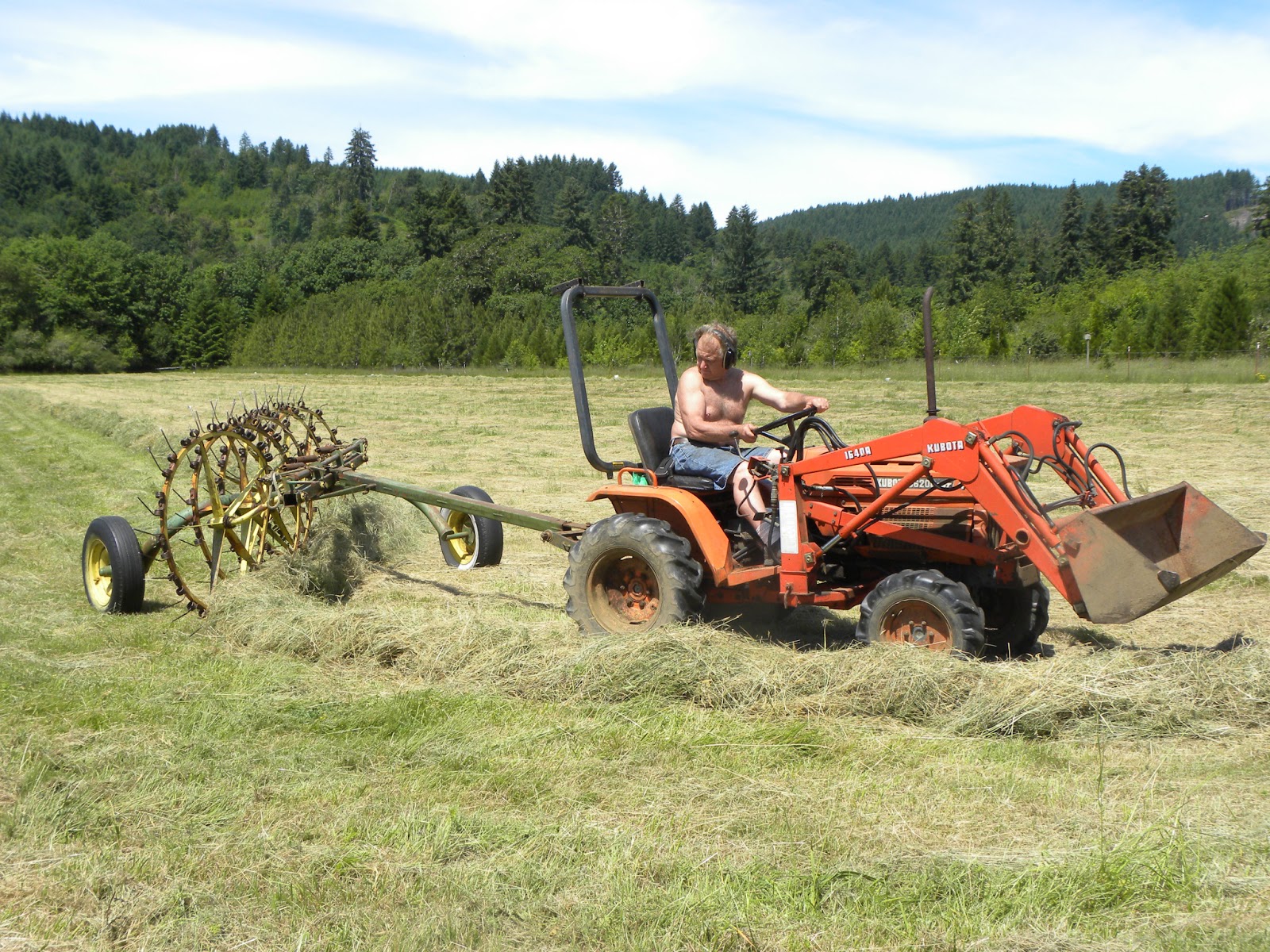
 Johnny raked on Thursday and Friday.


 Neighbor Paul baled on Saturday.


While Paul baled, neighbor Chuck threw bales onto the trailer for Johnny to stack. I drove the tractor.


 At the barn, Chuck put the bales on the hay elevator while I ferried them from elevator to Johnny the stacker in the barn loft. Here is the trailer after the last load was in the barn.


 This is a decidedly low tech operation compared to modern methods. We're just one step up from horse farming. But the hay is in the barn! And in bales light enough for us to handle. This is the first time we have picked up all the bales the same day they were baled. Since we cut a month early (it is almost never dry enough in early June to cut), we got less hay than last year. But with a little rain, which it looks like we will have, we may get a second cutting. Hooray!


Saturday, June 8, 2013

A Day On The Farm


A day on the farm (June 6, 2013, to be exact) in photos and videos...

     Some farm residents were working hard, like Johnny raking our hay fields...
          Video here: http://youtu.be/2F0jY1RpQPg


While others played king of the compost heap...
      Video here: http://youtu.be/azqMKeU68Rs


 And at least one rested in the shade... keeping his beautiful feathers safely up out of the grass and dirt.


Still others, of a wilder nature, competed for feathers to line their nests...
     Videos here: http://youtu.be/1Qxro7nCdnM  and here: http://youtu.be/0ogY_1DP1EM


And I took videos and photos... along with trimming horse hooves, weeding and planting... It was just a normal day on the farm.

Sunday, June 2, 2013

Valley Of The Giants

It's that time of year again, the time when we scout for our annual Breeding Bird Survey that starts in the Valley of the Giants, a 51 acre grove of Old Growth Douglas Fir a mere 12.7 miles from our farm. Unfortunately, only a bird could get there in 12.7 miles. Human types have to drive 60 some miles, most of that on gravel logging roads. It usually takes us 2 1/2 hours.

This year we took along three friends who had never been there before. Happily, recent rains kept the usually dusty logging roads nearly dust free and recent road work had wiped out the formerly monstrous potholes that made the last miles of the trip a nightmare. Our first stop was near a bridge where a break in the trees gave a view of a distant hillside with big trees and snags. There we located a former Bald Eagle nest, which made one of our crew, eagle monitor Michael, very happy. But it had not been used in a long time, probably because Valsetz lake and its fish no longer exist, the dam having been removed in the 80s. Here our happy crew is returning from a hike to look for another eagle nest, but that one had apparently disintegrated, or gone down in a wind storm with its tree.


 Michael brought along his tape and soon he and Johnny were measuring trees along the VOG trail. The biggest they measured was the first one, at about 30 feet in circumference or 9.5 feet in diameter... at least where they measured it. The others ranged from 23 to 28.5 feet (7.5 to 9 feet diameter). Big trees.


 But "Big Guy", the second tallest tree in Oregon when standing, is now on the ground.  According to Wikipedia, "Before 'Big Guy' was blown down by a wind storm in 1981, it was estimated to be over 600 years old, stood approximately 230 feet (70 m) above the forest floor, and had an estimated 36.5-foot (11.1 m) girth."

Carol slithers through the gap between two sections of the giant tree.


And here she models in the middle of a grove of the big trees.


 But Valley of the Giants is not just big trees. A beautiful stream flows through with a busy Dipper and a lovely bridge going over. The crew... Brian, Carol, Michael and Johnny... enjoy the view from either side.


 Michael and Brian both had Garmin GPS units and spent much of the day watching our progress on their little screens. Boys must have toys. Carol and I had a good laugh when we came to a fork in the VOG trail and were not sure which way led back to the van. Brian's Garmin pointed one direction and Michael's another. We followed Garmin-less Johnny. He was right.

Since our mission this day was to scout the BBS route,  after hiking the VOG trail we drove to our camping place and hiked in to my first stop... using clippers and an axe to help clear the way a bit. Hiking in the morning before daylight, as we must do on our BBS day, is a bit treacherous through all that brush and downed trees. Then we drove out, checking the rest of our 50 stops, each 1/2 mile apart, to make sure they were marked with mileage signs or other landmarks.

At the last stop, Johnny and I were surprised at how much taller the trees were than last year. This was a good year for growth. Michael stands atop the stump I used to be able to scan the former clearcut from, probably checking his Garmin to see where he is.


  Carol found a higher viewpoint on the van.


 And then we headed back to Dallas, dinner at the Ixtapa Mexican restaurant, and our respective homes.

Now all Johnny and I have to do is run the actual BBS... on another Sunday when the logging trucks are not on the road. Hopefully, it will be as lovely as today.