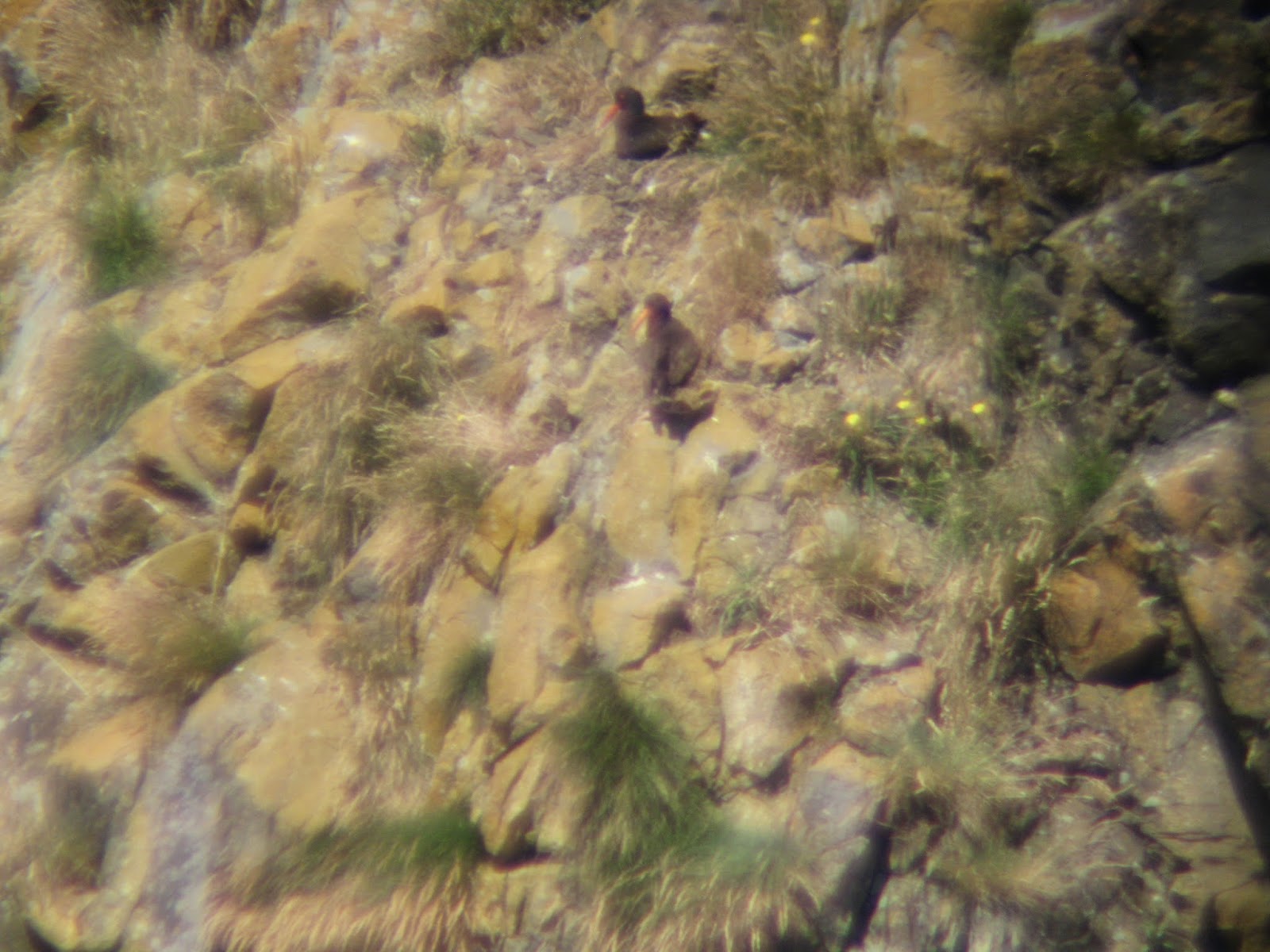
Although we were unable to see the chicks at Short Beach on July 2nd, our July 8th survey farther south, at Road's End, gave me a good view of the North nest rock chick. The two adults below have their backs to us. The chick is between them. If you look closely (or click on the photo to enlarge), you can see that the chick's bill is beginning to show color.
Here is a cropped version with parent and chick. The base of the chick's bill is starting to lighten.
Johnny could tell the Middle Rock parents at Road's End were feeding a chick but never saw the chick. Maybe next time. (That is our BLOY survey mantra... Maybe next time...)
After our customary lunch at the Jasmine Thai restaurant, we headed south to Boiler Bay with friend Dawn, who monitors four nests there. One had failed earlier, another had chicks that seem to have disappeared, a third had just hatched chicks, and the fourth was a mystery. This day, however, the mystery was solved when a chick came out to get something to eat that a parent brought. Johnny got this photo through the scope. Dawn has better ones. The chick is under the ledge with the adult between chick and camera.
The unusual thing about this nest is that it is not on its own offshore rock, like all the other nests in our area. Rather it is within twenty feet of another pair's nest... and now chick... on what we call Two Tone Rock. Usually pairs will not allow other BLOY within many feet of their nest rock. I'm wondering if these pairs might be offspring of the pair on a nearby rock that have been successful parents every year since I began paying attention to them. Dawn watched them fledge two chicks last year. Perhaps one of each of these two pairs, nesting so close together, are siblings. If only these birds had colorful leg bands or wing tags so we could identify them!
It was another great day at the beach: not too hot, not too cold. I look forward to our next survey.
Thursday, July 10, 2014
At the Coast
Although it has been hot on the farm with too much work to do, we take a weekly break, at least, for our bird and sea star surveys on the coast. July 2 was our sea star and Short Beach Black Oystercatcher survey, plus two bonus surprises at Cape Meares.
Up and down both coasts, sea stars are still dying and no one is sure why. Whatever the pathogen, the warmer ocean waters are suspected to be making it reproduce faster than the stars can fight it off. We are asked to survey the same beach every two weeks to follow progress, or regress. There is worry that all the sea stars will die out. We survey at Short Beach on the same day we try to find the Black Oystercatcher chicks there.
After having to catalog and photograph all those sick and dying sea stars, it's good to look up and see that the view is still lovely.
Although we could see that the Black Oystercatchers were flying to their nest ledge with food, we could not see the chicks. On an offshore rock not far from the beach this BLOY gathered food and flew toward the ledge.
But we were at the wrong angle to see what he delivered it to... A little black bird with red bill is in the center of the following photo. The nest area, we learned last time, is around the corner left. We could only view it from up on the road... very far away.
So with the sea star survey completed, we hiked back up to the road. I saw a BLOY fly up, presumably to feed, but whatever he fed was in the shadows and invisible. That tiny black bird with the red bill is even tinier from this distance, right where he was before but at a different angle. He is on the ledge to the right of the dark hole. The chicks are not out in view... at least I can't see them.
We then drove the two miles from Short Beach to Cape Meares to see if we could find the BLOY that had, from all reports, disappeared from their usual nesting areas.
First we checked the distant Peregrine nest ledge and saw... something... within.
Eventually, the something materialized into a big fluffy white Peregrine chick. Then an adult flew in with prey and a second chick appeared! Johnny took these photos with his camera shooting through a scope.
Meanwhile, I was watching, from a lower viewpoint, an Oystercatcher that Johnny had spotted... hoping it would take me to a nest. After a very long time of watching it standing on the side of the cliff doing nothing, I realized that there was a second BLOY nearby... on a nest! Johnny took this photo of the two birds, after one had moved closer to the nesting bird, through the scope. At one point, the setting bird stood and I was able to see an egg. There were probably more but the bird didn't stay up long enough for me to know.
What a great day of discoveries at Cape Meares! It was made even more fun after we picked up a late lunch at the Netarts deli, met our Tillamook friends the Woodhouses and drove to Cape Lookout State Park to eat... and scope the offshore rocks for BLOY. None found but we did see an eagle chick in the eagle nest visible from the road. It was too camouflaged for a photo. Maybe next time...
Wednesday, July 9, 2014
What a Weekend
The long Independence Day weekend started well enough with a spectacular, long-lasting and ever-changing sunset on the eve of the 4th.
Since the 4th of July was on Friday, we thought it best to avoid holiday traffic by heading to Valley of the Giants on Saturday evening for our once-a-year Breeding Bird Survey starting early Sunday morning. Life had just been too busy earlier in the survey window, which would close on July 7th. Plus the Marbled Murrelets, the reason this route was created (along with Spotted Owls, but they are apparently gone), are more vocal in July when they return from the ocean at dawn to the big moss-covered limbs of old growth trees to feed their chicks, calling as they approach their nests.
Unfortunately, we were still having issues with Jessie Anne chewing down the barn in her frustration at not being allowed out on grass. (Story in previous blog entry.) So we spent much of Friday and all of Saturday covering all the posts that hold up the barn with either metal or chicken wire. I didn't want Jessie Anne (with a little help from her daughter Nightingale) chewing those posts in two while we were gone. It is always hectic getting all the animals set up so we can leave the farm overnight, but the horse situation greatly complicated the process this year.
I milked the goats and fed everyone early and extra Saturday evening since we would not be back until noon or after on Sunday. We stay overnight and start the route at 4:58 a.m., after walking in half a mile to the first stop. For the first time in the eight years we have run this route, we did not scout it first to check road conditions and clear that half mile hike through brush. Big mistake.
After a two hour drive, we arrived as the sky was darkening just before 9 p.m. and hurried to clear the trail, which seemed longer than usual. The brush, mostly thorned, towered over our heads and we lost our way several times. I wondered if we'd ever find the "sitting log" where we can look up at a known Marbled Murrelet nest tree to start our survey. But at last, we did... in near dark. Then we hurried back on the sort-of cleared trail before it turned pitch dark.
The alarm went off at 4:15 a.m. We ate a quick breakfast and used our flashlights to guide us to the sitting log without tripping too many times. Apparently, the Murrelets were sleeping in that morning as we did not hear them there. After our 3 minute survey, we hurried over logs and through bushes back to the van at Stop #2 where we again heard no Murrelets (but plenty of other birds: the "dawn chorus" was now in full swing). At Stop #3, a half mile down the road, I heard the first Murrelets. What a welcome but weird sound to hear sea birds in the middle of an old growth forest. We heard them at two more stops in Valley of the Giants before it either grew too late for their flight calls or our stops were too far out of the old growth forest they need for nest sites.
Besides the usual horde of singing Swainson's and Varied Thrushes, Pacific Wrens and Pacific Slope Flycatchers, we heard Band-tailed Pigeons almost every stop and many Western Tanagers. I snapped a photo of this handsome Tanager singing atop a tall fir (No, I didn't take time out from the timed survey: I was listening for birds while I took the blurry picture).
And then I took a picture of one of the Band-tailed Pigeons that posed so often.
We rushed from stop to stop to complete the route in the preferred five hours... and almost made it this year. We would have made it handily if it were not for two heart-stopping incidents on the way down. Gates that were open when we drove up Saturday night were closed when we drove down early Sunday morning. There is no cell phone service up there and it would have been a long walk and many hours out. Fortunately, the gates were shut but not locked so we were able to drive through. Although Valley of the Giants is owned and managed by BLM, the roads going up to it are owned by private timber companies who can shut the gates whenever they want to keep the public out. Perhaps they were closed now for fire danger, moved up from "low" to "moderate".
Two hours after completing the route, we were home again and I hurried out to feed horses and milk goats. It was hot by this time. It looked to me like our wire and pipe wood protection had worked as I saw no new chewings by Jessie Anne in the area she had access to. Mr. Smith is locked into the barn area to eat his food or else he'll chase the mares away and eat theirs, too.
Later that afternoon when Johnny went out to try to fix a water leak by the horse barn, after I had turned Mr. Smith back with the others, Jessie Anne was inside Mr. Smith's area, chewing on everything wood. So we spent the rest of the hot and muggy day protecting the wood inside Mr. Smith's area, this time with big white PVC pipe slit to fit around the round fence poles that were Jessie Anne's latest target.
My new routine is to get up very early, feed the horses, chickens, llamas, sheep, dogs, then let the horses out into the pasture -- with grazing muzzles on -- after they're done eating their special and expensive low-carb hay cubes. The grass is supposed to be safest between 3 a.m. and 10 a.m. Well, I'm not getting up at 3 a.m. but 6 a.m. to 9 a.m. is plenty of time for them to gallop and cavort... and eat grass, before I bring them in for more of their hay cubes. Here's hoping that amount of freedom will be enough to keep Jessie Anne from destroying anything else. And here's hoping the pasture becomes "safe" very soon.
Friday, July 4, 2014
Farewell to June
The last week of June was busy and rather stressful. Johnny spent it mostly hauling more used fencing wire and posts home from Nancy and Dick's. We now have a lot of fencing material.
I spent the week, as always in June, weeding, mowing, digging tansy, weeding, mowing. And there were crises. Nightingale colicked. I walked her and called the vet. By the time he arrived, she was better and I was calmer. But probably her one hour on grass that morning had not been a good thing. The horses hate being off grass and started chewing their prison down... or all of it that is wood that they can reach. So Johnny spent several days covering the wood with plastic pipe.
Now they're eating the posts they can still reach.
I've ordered Chew Stop. They get out with muzzles on for an hour in the early morning in a small area I mowed and electric-fenced off. And they get fed hay cubes several times a day, instead of just twice like when they're out on pasture. I'll be glad when the grass dries up and the horses can be out full time again.
In between all the work, we went to the coast for a day of Black Oystercatcher surveys. Johnny saw a chick on the Middle Nest Rock at Road's End while I saw the chick on North Rock that I had found the week before.
Also on the North nest rock were three new Western Gull chicks. I didn't know they started out spotted!
We surveyed Cape Kiwanda earlier that day but found only one non-nesting pair of Black Oystercatchers, plus a Peregrine Falcon.
We checked Neskowin's Refusal Rock, too, where a pair has nested in the past, but saw none. I guess they refused this year.
That survey day was long and tiring. But the scenery, as always, was beautiful. Below is my view looking south from my north observation point at Road's End. The South nest rock and Middle nest rock (among others) are in this photo. The South nest rock pair have apparently lost their eggs and left town.
The rest of the week I trimmed horse hooves (I can only trim one horse a day before my back and hands give out) along with the usual weeding, pulling tansy, etc. The hooves look good and the horses are sound so the dry lot is working, even though the horses hate it.
On Sunday, we built snow fence and metal fence barricades with netting on top around the producing blueberry bushes. Our free-roaming peacock had been picking blueberries as soon as they showed any blueness. Hopefully the barricades will allow us to eat some blueberries this year. Last year I draped netting over them. That made picking difficult for me but didn't seem to slow the birds down much.
The roses are lovely in June. I managed to weed and spread barkdust under them, but not take many photos. Here is one of Armada, always in bloom.
And blurry ones of Paul's Himalayan Musk that climbs way up the poplar in our front yard and hangs completely over the driveway. But it only lasts through June.
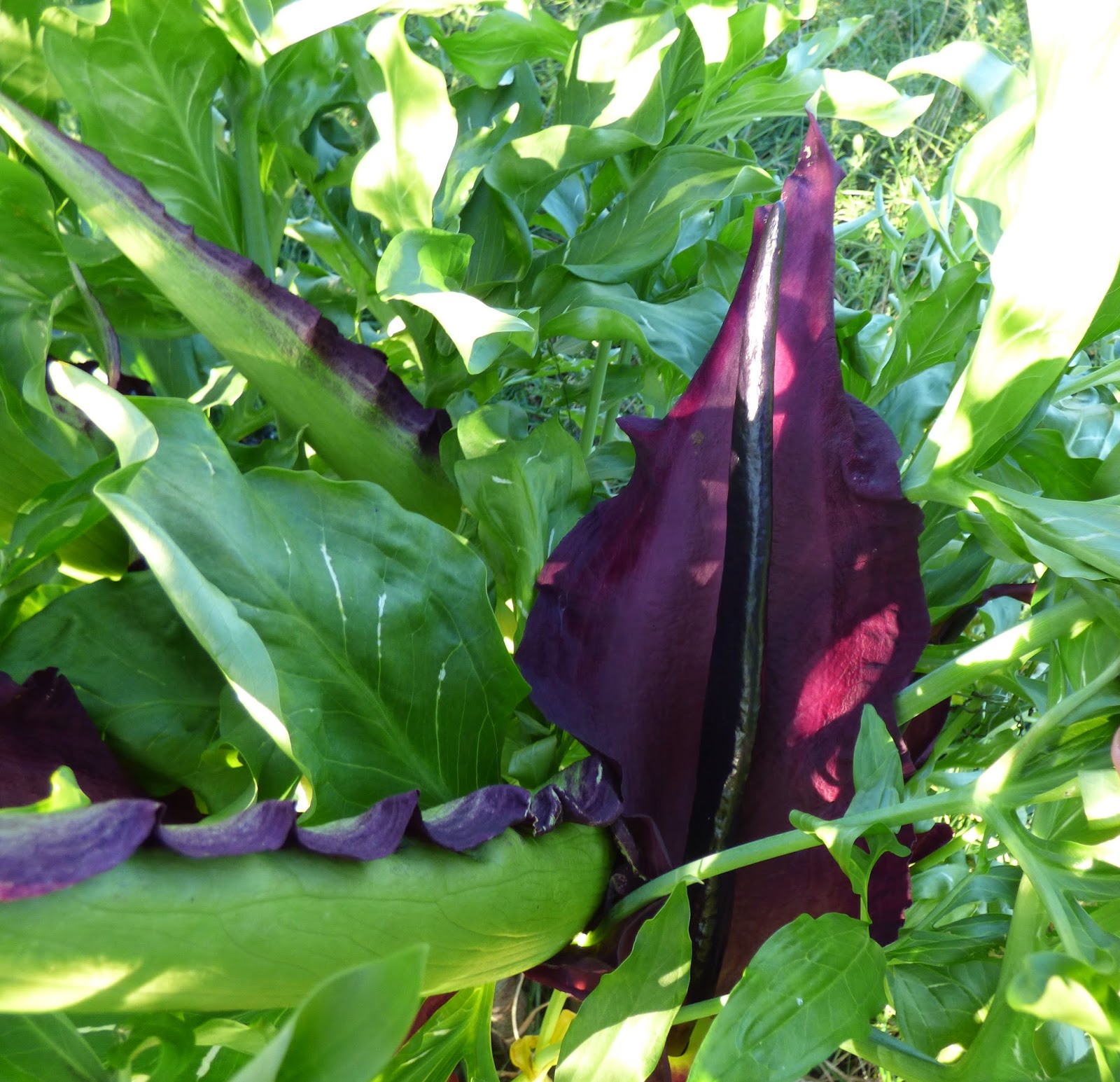
The weird Voodoo Lily in the arboretum only blooms in June, too, which is probably a blessing considering how awful it smells when it first opens.
Goodbye June... and hello July...
![]() |
| wire |
![]() |
| gates |
| metal posts |
| wood posts |
| more wood posts... these are being treated in used motor oil |
I spent the week, as always in June, weeding, mowing, digging tansy, weeding, mowing. And there were crises. Nightingale colicked. I walked her and called the vet. By the time he arrived, she was better and I was calmer. But probably her one hour on grass that morning had not been a good thing. The horses hate being off grass and started chewing their prison down... or all of it that is wood that they can reach. So Johnny spent several days covering the wood with plastic pipe.
Now they're eating the posts they can still reach.
I've ordered Chew Stop. They get out with muzzles on for an hour in the early morning in a small area I mowed and electric-fenced off. And they get fed hay cubes several times a day, instead of just twice like when they're out on pasture. I'll be glad when the grass dries up and the horses can be out full time again.
In between all the work, we went to the coast for a day of Black Oystercatcher surveys. Johnny saw a chick on the Middle Nest Rock at Road's End while I saw the chick on North Rock that I had found the week before.
| North Rock parent with chick lower right |
We surveyed Cape Kiwanda earlier that day but found only one non-nesting pair of Black Oystercatchers, plus a Peregrine Falcon.
| One of the two foraging, non-nesting, Cape Kiwanda Black Oystercatchers |
| Peregrine Falcon |
We checked Neskowin's Refusal Rock, too, where a pair has nested in the past, but saw none. I guess they refused this year.
| Refusal Rock |
That survey day was long and tiring. But the scenery, as always, was beautiful. Below is my view looking south from my north observation point at Road's End. The South nest rock and Middle nest rock (among others) are in this photo. The South nest rock pair have apparently lost their eggs and left town.
The rest of the week I trimmed horse hooves (I can only trim one horse a day before my back and hands give out) along with the usual weeding, pulling tansy, etc. The hooves look good and the horses are sound so the dry lot is working, even though the horses hate it.
On Sunday, we built snow fence and metal fence barricades with netting on top around the producing blueberry bushes. Our free-roaming peacock had been picking blueberries as soon as they showed any blueness. Hopefully the barricades will allow us to eat some blueberries this year. Last year I draped netting over them. That made picking difficult for me but didn't seem to slow the birds down much.
The roses are lovely in June. I managed to weed and spread barkdust under them, but not take many photos. Here is one of Armada, always in bloom.
And blurry ones of Paul's Himalayan Musk that climbs way up the poplar in our front yard and hangs completely over the driveway. But it only lasts through June.
The weird Voodoo Lily in the arboretum only blooms in June, too, which is probably a blessing considering how awful it smells when it first opens.
Goodbye June... and hello July...
Friday, June 27, 2014
Johnny's Homecoming
Johnny came home from his week away on Thursday, June 19. Naturally, we spent Friday surveying birds. First there was the Beached Bird Survey where we canoed across the Salmon River, watching an eagle soar overhead. As we hiked the beach looking for dead birds, we found a dead sea lion first. About fifteen Turkey Vultures and one Bald Eagle were either feasting on the carcass or waiting their turn to do so.
I have this dream that someday, it will be California Condors feasting on dead sea mammals, as there was years ago... But this day, it was Turkey Vultures.
On our lunch break at the end of the beach before turning around for our return trip, Johnny spotted a Black Oystercatcher foraging on a tidal rock... probably one of our Road's End North Nest Rock birds, gathering food for a chick or chicks. It was time for the eggs to hatch. Our next stop would be Road's End where I hoped to see a chick. (That tiny black dot silhouetted against the surf is the BLOY.)
On our return trip up the beach we found, for once, a beached bird that was not a gull. Johnny found one wing, then searched until he found the second. The vultures had been spreading our bird carcasses all over the place. Here is our first beached Pigeon Guillemot, or what was left of it: two wings.
The wind was blowing onshore as we canoed back to Knight Park and our van. I made a sail with my coat and two paddles. Johnny had only to use his paddle as a rudder. Fun!
Then we were off to Road's End and our hikes up to BLOY observation points: Johnny on The Thumb, watching the South and Middle Rock nest areas; I to the North post, looking down on the North Nest Rock... and, I hoped, new chicks.
The adults certainly acted like they had chicks, one standing guard while the other went off to forage, chasing away interlopers... but no chicks could I see... for two hours. Finally, a parent brought food and a single chick came out of hiding. Parents are top right and bottom left with the tiny chick about halfway between them, heading left.
The little family then marched down to a pool in the rocks. One parent went into the pool, drank and took a bath while the chick stood with its feet in the water and the other parent stayed on shore, standing guard.
After a bit, the chick got brave and splashed like the parent had done.
I don't know what happened to the other two eggs, but this seems to be very common in the Black Oystercatcher nesting world: lay three eggs and, if lucky, fledge one. Hopefully, this chick will survive to fledging.
Before leaving, I admired the view northward, as always, toward the rocky headland between me and Cascade Head. One of the tidal rocks beyond the headland is where Johnny had seen a BLOY when we were doing our beached bird survey. The beach beyond the headland was the beach we surveyed.
Two little black dots on the beach are likely the dead sea lion and its vultures. I like them better at this distance.
We ate supper at our favorite Thai restaurant in Lincoln City and headed home. That night, we sat behind the house and watched fledgling Barn Owls fly in and out of the oak tree, begging for food. How could Johnny ask for a finer first day home?
Subscribe to:
Posts (Atom)