Thursday, May 22, 2014

Bird Survey Madness, Day One

Every May, a survey of Black Oystercatchers is taken over the entire Oregon coastline. Johnny and I survey from Lincoln City north to Cape Lookout. The BLOY (as we call them) hang out on offshore rocks, so our area is really only the rocks off Road's End plus Cape Kiwanda and Cape Lookout. Cascade Head, or at least Hart's Cove, is surveyed by the USFS so we don't go there even though it is within our area. Later in the season, I check for nests there.

The initial survey takes place during one week in May, beginning Mother's Day weekend. Our first survey day was reported in a previous blog entry.   http://lindafink.blogspot.com/2014/05/a-whale-of-day.html  A follow-up survey is conducted at each site within a week, hopefully, of the last visit.Tuesday and Wednesday of this week we did our follow-up surveys. Since the timing worked to combine with our Beached (dead) Bird Survey, we canoed across the Salmon river on Tuesday, hiked the beach looking for dead birds (found none), canoed back across and drove to Road's End.

On this trip Johnny hiked up The Thumb to our usual observation post, while I hiked to the top of the cliff, then down around the cove that is north of The Thumb to where I can look down on the North Nest Rock birds and actually see their nest. Photos of this insanely difficult trek follow.

Of course, the first rule of a long, steep hike is to stop and take photos of flowers (and breathe).


That bump on the left in the photo below is the top of The Thumb, where we usually sit to watch BLOY. Johnny was on his way up there when I reached the top of the cliff far above him.


Thanks to the zooming wonders of my Panasonic Lumix camera, there he is, on his way up.


And even closer...


Far, far below me was the cove that lies north of The Thumb. My goal was its north rim, a long way down through a trail-less jungle. But it would not have taken me an hour if I had not managed to get lost and had to back-track. Next time I'll be faster.


 Johnny spotted me when I finally appeared across the cove from him. I'm a dot in the lower left of the photo below.


And zoomed closer... I'm standing in the middle of the salal field looking down on the North nest rock.


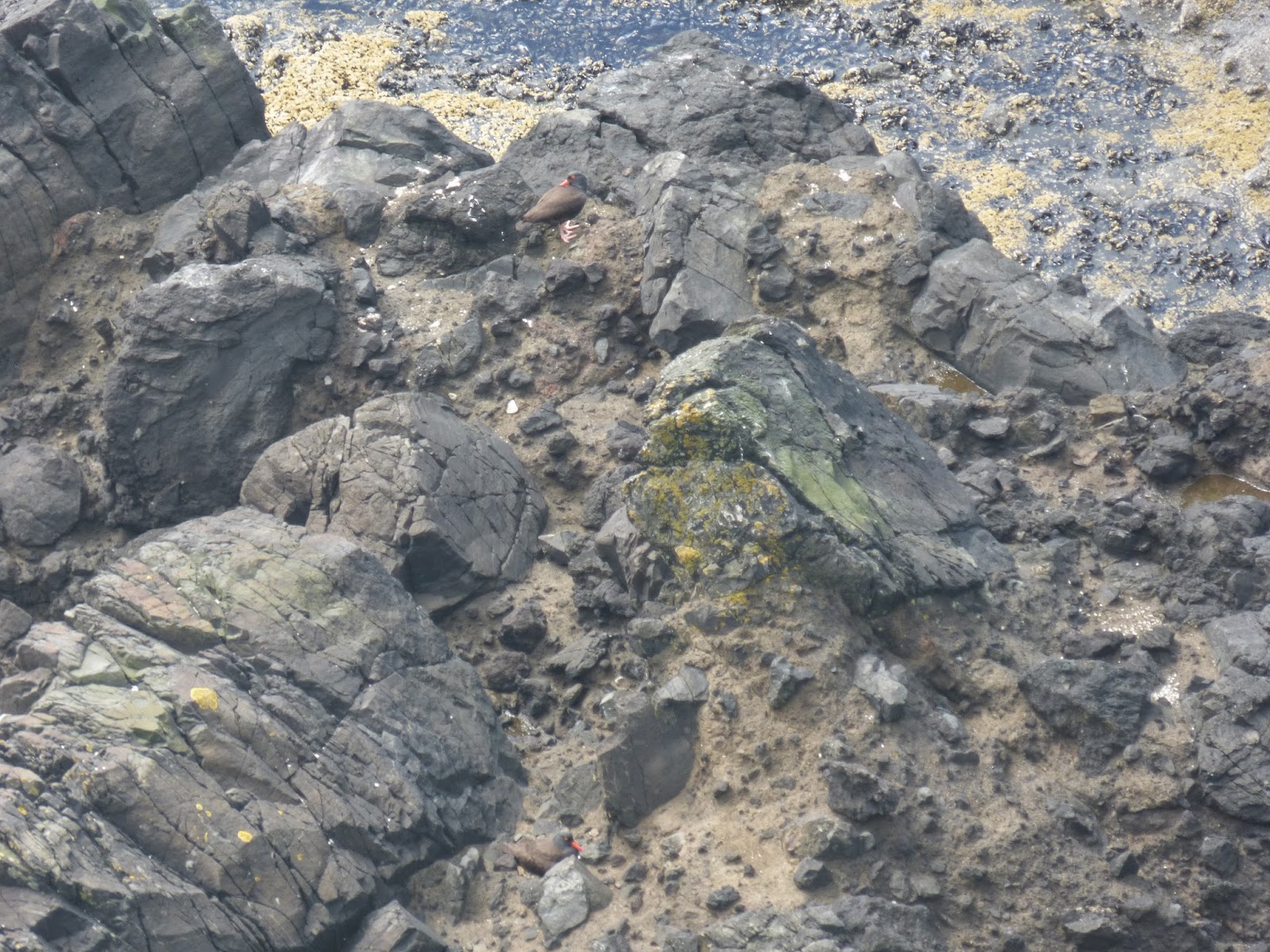
And here is the rock. Try picking out black birds on this rock!


It took a while, but I finally spotted red bills. The setting BLOY is in the bottom of the photo just left of center. The guarding BLOY is at the top just left of center.


Here is the one on the nest, closer.


And the BLOY on guard duty.


Johnny could see neither bird from his position atop The Thumb. That knob on the left of the photo is The Thumb.


The dot in the middle of the two trees is Johnny looking through his scope at the nest rocks below.


Here he is...


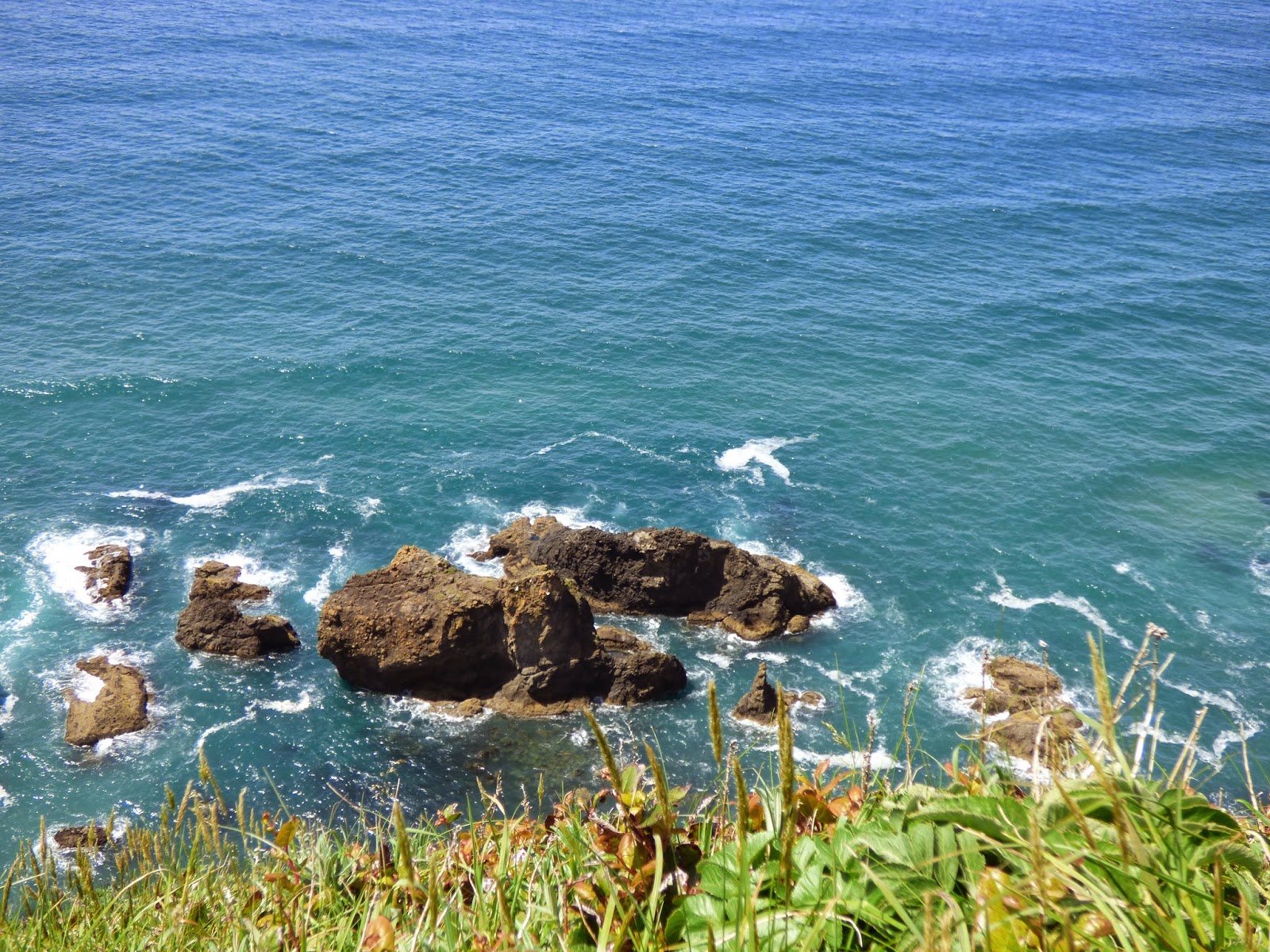
Mission accomplished, I headed back. But first I stopped to take a photo of the incredible view looking north. Camp Westwind's Crescent Cove was just below me. The long beach beyond the rocky outcropping in the middle of the photo is where we had just done our beached bird survey. And beyond that: Cascade Head. The view alone was worth the hike. (In retrospect.)

But then it was plow my way through salal, crawl under and over the stunted-by-wind sitka spruce, to travel the long way up, down and back to the van that was topped with our beached-bird-survey canoe. Naturally, I took photos of flowers on the way down.


We ended our day on the coast with dinner at the Nepali restaurant in Lincoln City, joined by friend and fellow BLOY enthusiast, Caroline.


 The next day, we did our follow-up surveys of Cape Kiwanda and Cape Lookout: two more long, strenuous hikes. Crazy, yes?


Sunday, May 18, 2014

May Flowers, Indoors and Out

Today's plan was to lock up the wooly ewe and shear her before her wool got wet again in today's rain. The first part of the plan worked splendidly. I fed grain while Johnny snuck around behind and closed the make-shift panel gate, tying it closed with twine. Then he went to church while I confidently did chores.

When morning chores were done, I took the sheep shears to the sheep. Well, I started to. I had not got inside the pen before Matilda (as some visitor named our lone ewe) charged the gate, broke the twine and fled. There is no way to catch Matilda when she is outside a pen. She may be heavy with wool, but she's still ten times faster and more agile than I am.

To be honest, I was not looking forward to shearing that enormous sheep. I grabbed a camera instead of shears and took photos of flowers. Sunday is my day of rest anyway. Or it became such after Matilda's escape.

Rhododendrons everywhere in western Oregon this spring are spectacular. We only have two but they are covered with flowers.


Years ago, friend Velta and I went through an Iris phase: we planted many different varieties in our respective gardens. Both of us found out that iris do not like to be smothered in grass, which is what grows best around here. So the iris became mostly leaves and no flowers. Last year I made an effort to clear the weeds away from their feet. Either this happens to be a very good year for iris, as it is for rhodies, or my efforts paid off.


Lots more is blooming along with the iris. The Snowball bush is loaded with white flowers.


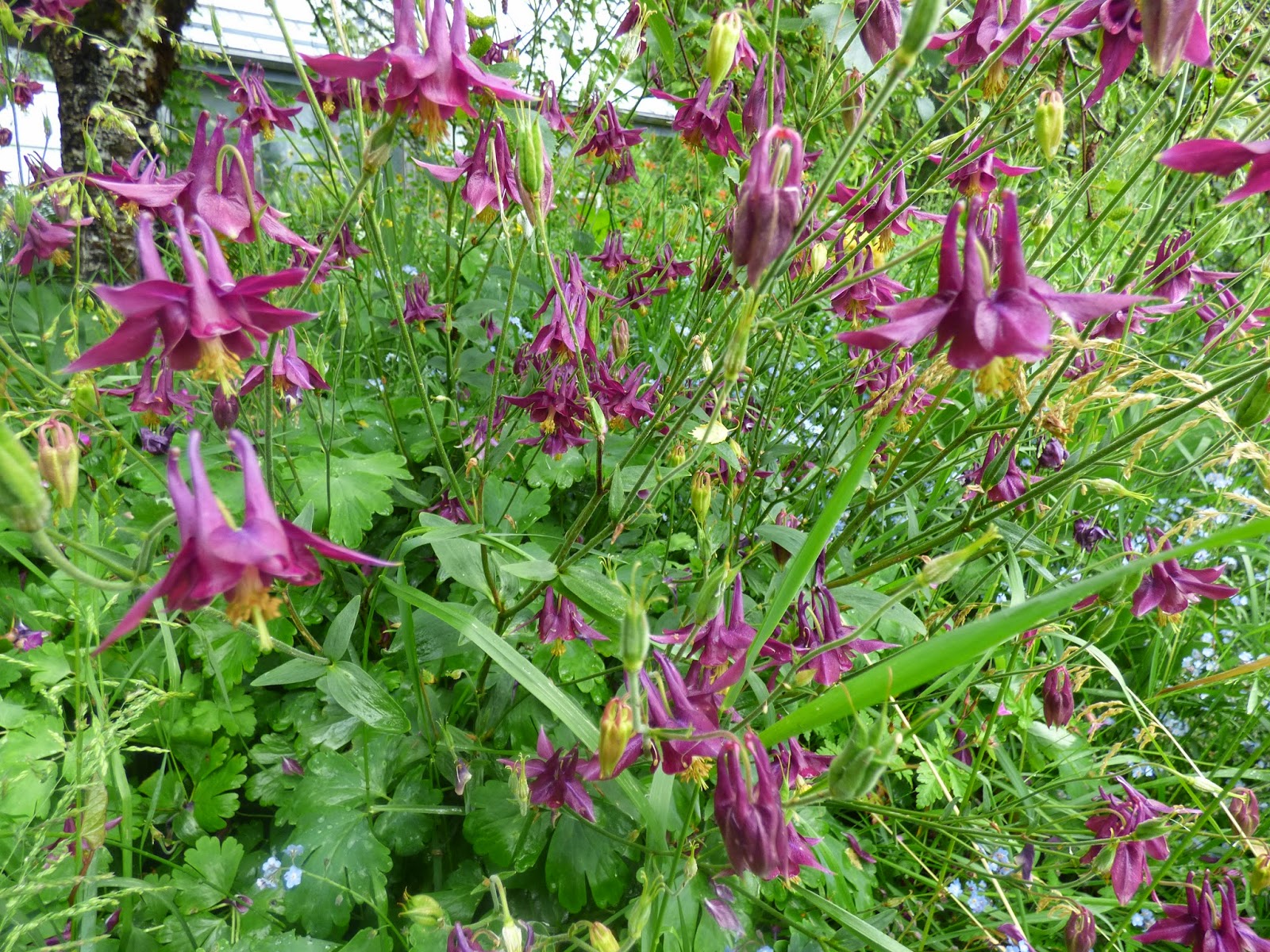
Columbine is thick and colorful in my flower "meadows".


Spring starts out with yellow flowers, mostly, it seems, but purple seems to be the dominant color right now. Even the chives carry through with that theme.


As does the Silver Moon clematis, just beginning to bloom against the house.


Inside the greenhouse, warmer colors predominate. Like this just-beginning-to-bloom orange geranium.


And the orange begonia...


May is the month that most of the orchid cactus (epiphyllum) bloom.


The amaryllis have been blooming for some time, mostly red ones. But this variegated plant has several blossoms open now.


Pink geraniums seem to be always in bloom somewhere in the greenhouse.


The most exciting flower of all doesn't look like much, but produces delicious babaco papayas. After the plant broke last year (http://lindafink.blogspot.com/2013/03/tragedy-in-greenhouse.html), I stuck three stem pieces into pots and now have three towering babaco papaya plants. A few papayas are beginning to enlarge.  They take a long time to mature, but it will be fun to watch them grow. And when they're ripe, we'll make babaco papaya ice cream again. (http://lindafink.blogspot.com/2013/04/babaco-papaya-ice-cream.html)


I should probably thank Matilda-the-sheep for giving me a day off to admire the flowers.

Friday, May 16, 2014

A Whale of a Day


We took a day off from planting the garden (me) tilling up the weedy chicken yard (Johnny), mowing (both of us), and many other farm projects, to do a Black Oystercatcher (BLOY) survey on the coast. It was predicted to be very hot at home so going to the coast seemed like a good idea.

Oftentimes when it's hot inland, it's foggy and cold near the ocean. But not yesterday. It was 80 degrees with no wind and no fog. Amazing weather.

Road's End was our survey site for our planned easy, restful day. We were first delivering some more of our old barn wood to friend Dawn in Lincoln City, who has been turning it into lovely bookcases and other woodworking projects and has promised to make one for me. Then it was lunch at our favorite Thai restaurant. And a beautiful hike up to the top of The Thumb at Road's End.


Almost as soon as we arrived, Johnny spotted one bird on the very distant North Nest Rock (our name). It's a great help that we now know where on which rocks the three pairs at Road's End like to nest. Without a good eye and a good spotting scope, this little black bird on North Nest Rock would be hard to detect.


Although we know exactly where on the south rock (that we call Original Nest Rock) the BLOY traditionally nest, we could not see a bird, although we could hear one calling from time to time.


But finally I spotted it. Black bird against black rock. Only the red bill gives it away.


Here it is zoomed up in the camera to blurriness.


We were so intent on searching for these black birds with red bills that we did not notice the pod of whales going by until a teen-aged girl came rushing down toward us from the top of the Thumb hollering "Do you see the whales?!" We had not. They were cruising right below us, just beyond our BLOY nesting rocks. Johnny counted 5 or 6 adults and at least 2 calves. The girl and her friend were from the Outdoor School at Camp Westwind, just north of this promontory where we survey BLOY. I'm very glad they alerted us!


Gray whales go south in the winter to calve in warmer waters and then back north in the spring. The cows with calves tend to stay close to shore to avoid deep water predators, or so I've been told.

After the whales passed, it was back to BLOY watching. We soon saw a single bird on the northwest pair of Middle Rocks. They nest on the southeast rock but the one not on a nest often stands guard on the nearby rock, where it can see the nest area.

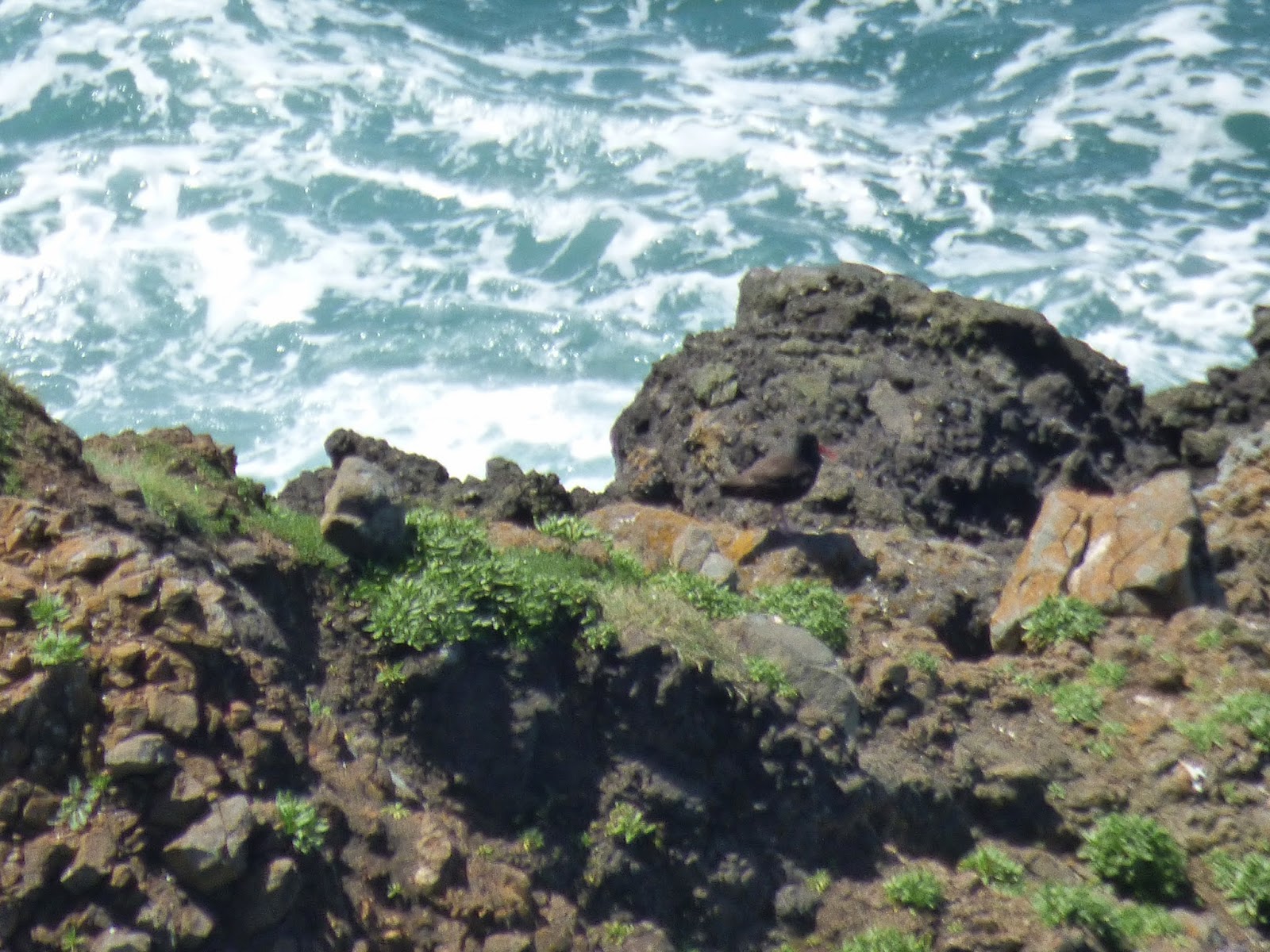
 Even though a BLOY is silhouetted against the surf in the photo below, it is very hard to pick out. When Johnny first spotted the bird, it was against those dark rocks.


Here it is zoomed up, right on top where they like to be. And where I like them to be so I can see them!


After we had watched nest exchanges on the Original Nest Rock and the Middle Nest Rock, and saw the North Nest Rock BLOY on guard duty, we packed up our gear and hiked back down. We had time for a mid-day snack in Pacific City and then a short side-trip to Cape Kiwanda.

We had seen a dead seal on the beach Sunday, during our BLOY survey there, which we thought was another Northern Elephant Seal, like we found on last month's COASST (beached bird) survey across the Salmon River. But we had taken no photos. We did that now and sent them to the beached mammal biologist at Oregon State who had identified the Northern Elephant Seal for us last month. He replied that it was a Stellar Sea Lion, probably long dead and decomposing before washing up on the beach. (The photos are too grisly to post here.)

It was still fairly early in the day, so we drove on to Cape Lookout to look for livelier creatures. We often see or hear BLOY there but have not yet located a nest. It is a very difficult area to survey because there is almost no visibility of the rocky habit Oystercatchers like. And it's a very long hike (nearly two and a half miles one way) on a path over tree roots to the tip of the cape. But it was a lovely day and I did not want to return home where it was almost certainly much hotter.

Here Johnny stops on one of the more civilized parts of the trail to admire the big trees.... or something. Or maybe he was just waiting for me to catch up.


 My method for surviving long hikes is to stop often and take photos of flowers... and catch my breath.

False Lily of the Valley: Maianthemum dilatatum


 Half way out to the end of the cape is a view of a rocky outcropping that I've always thought should have a pair of BLOY on it, but never has. Until this day. Almost too far to pick out with binoculars (and we had not brought a scope on the hike with us), two tiny black birds with red bills were standing on the rock. My camera was able to see them better than we could.


And my photo program brought them even closer.


Then it was more hiking to the end of the Cape in hopes of hearing or seeing more BLOY there... or more whales. Fortunately, there were more flowers along the trail to provide a bit of respite.

Indian Paintbrush: Castilleja sp.

What we saw all along the south side of the cape were huge and noisy rafts of Common Murres. There were thousands of them and their constant chatter sounded like angry cats fighting.


We neither heard nor saw BLOY at the end of the cape. No whales, either. But the view looking south toward Cape Kiwanda was lovely.


Zoomed up in the camera, the cape and the Rock looked much closer than they are!


The long walk back found more flowers, naturally.

Clasping Twisted Stalk: Streptopus amplexifolius 

Milkmaids:
Cardamine californica var. integrifolia


And then, just as the trail was about to enter the forest and leave the view of ocean, I spotted whales! While I tried rather unsuccessfully to get pictures of the whales so far below us, Johnny counted: 6 adults and 3 calves. We think it may have been the same pod we saw from Road's End, six hours earlier. This was the only smudge in the water more or less identifiable in my photos as a whale.


When we finally reached the trail head parking lot, we decided to drive the one mile farther to the only other place we have seen or heard BLOY at Cape Lookout. There are two large rock islands out in the ocean a long way and through many trees from this pull-out on the road, but with a scope we had seen BLOY there a few times in past years. We did not see any this time, as we peered through tree branches at rocks a very long way away, but we did hear one. By then it was 8:30 at night! So we headed home.

Our "easy, restful" plan to survey just at Roads' End had morphed into one whale of a day.